AI brand visibility measures whether platforms such as ChatGPT, Gemini, Perplexity, and Google’s generative search experiences mention, cite, describe, or recommend your company when buyers research a problem.
It is becoming commercially relevant because the buyer does not always click directly from the AI response.In a 2026 study, Similarweb found that users who received an AI brand recommendation were 2.5 times more likely to visit the recommended company’s website within seven days. Approximately 56% of those AI-influenced visits arrived through search, compared with about 40% of standard visits.
For business leaders, the implication is clear: AI visibility and traditional SEO are not competing initiatives. AI can create awareness and branded demand, while search captures that demand and moves the buyer toward a decision.
What Is AI Brand Visibility?
AI brand visibility is the degree to which generative search platforms recognize and surface your company in response to relevant questions.
A brand can appear in several ways:
| Visibility type | What it means |
| Mention | The AI system names your company in an answer |
| Citation | Your website or content is linked as a supporting source |
| Description | The system explains what your company offers or is known for |
| Recommendation | Your company is placed on a shortlist of providers, products, or solutions |
| Comparison | Your brand is evaluated against one or more competitors |
This differs from traditional search rankings.
A conventional SEO report may tell you that a service page ranks fourth for a target keyword. An AI visibility audit asks a different question:
When a buyer asks an AI platform which companies they should consider, does your brand appear at all?
A business can perform well in conventional organic search and still be absent from AI-generated recommendations. It can also be mentioned in an AI response without receiving a directly attributable referral click.
That attribution gap is where the commercial impact becomes easy to underestimate.
What the Data Says About AI Recommendations and Website Visits
Similarweb’s downstream-impact study followed thousands of user journeys across the finance, travel, and beauty industries.
The researchers examined users who:
- Asked ChatGPT an industry-related question
- Received a specific brand recommendation
- Had not recently visited the recommended website
- Had not already named the brand in the prompt
- Were then observed for the following seven days
Users who received a brand recommendation were 2.5 times more likely to visit that brand’s website than users who received a competing recommendation.
The study also reported:
| Measurement | AI-influenced visits | Standard visits |
| Visits arriving through search | Approximately 56% | Approximately 40% |
| Pages viewed | Nearly 2× higher | Baseline |
| Time spent on site | Nearly 2× higher | Baseline |
These results should be treated as observational evidence, not proof that every AI mention directly causes a sale. The research covered selected industries and one part of the customer journey.
However, it demonstrates an important behavior that conventional attribution systems frequently miss: a recommendation can influence a later visit even when the user never clicks a link inside the AI platform.
AI Visibility Can Create Demand That Search Later Captures
Consider the following journey:
- A buyer asks an AI platform for the best providers in a category.
- The platform recommends three companies.
- The buyer remembers one company but does not click immediately.
- Several days later, the buyer searches the company’s name.
- The resulting visit is recorded as branded organic search.
- The original AI interaction receives no attribution.
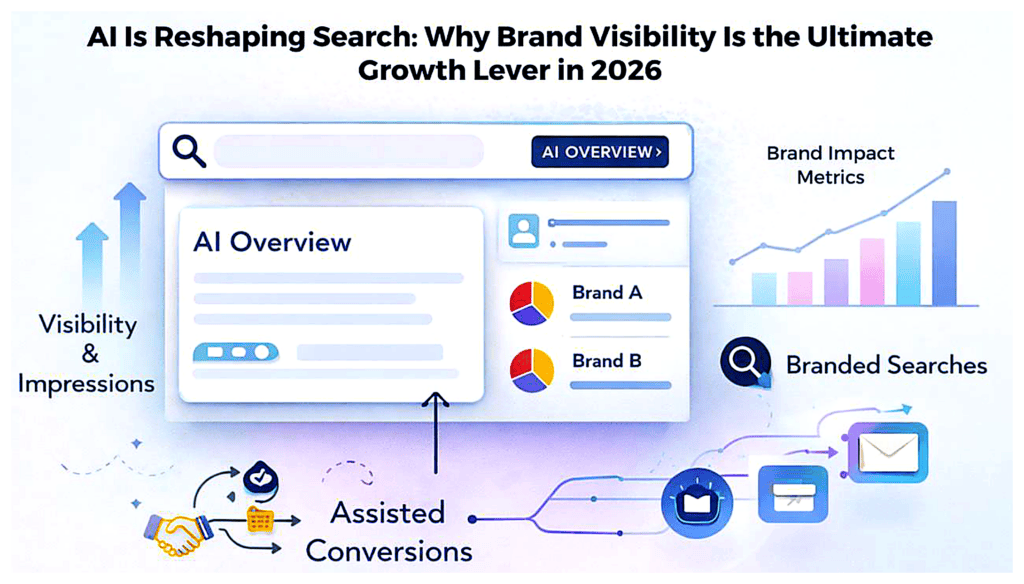
From a reporting perspective, Google Search appears to have generated the visit. In reality, the demand may have originated earlier in the AI-assisted research process.
This changes how operators should interpret branded search growth.
An increase in searches for your company name can reflect several influences:
- AI recommendations
- Public relations coverage
- Social content
- Podcasts and video
- Offline exposure
- Paid media
- Word of mouth
- Marketplace visibility
- Industry citations
That is why AI visibility should not be evaluated through referral traffic alone.A more useful measurement framework connects AI mentions with changes in branded search, direct traffic, engagement, qualified leads, and revenue.
Why AI Visibility and SEO Should Be Managed as One System
Google’s official guidance states that established SEO practices remain relevant for generative search features such as AI Overviews and AI Mode. Google also says there are no separate technical requirements or special AI-specific markup needed to become eligible for these experiences.
Its generative AI optimization guidance emphasizes the same foundations that support sustainable organic performance:
- Helpful, original content
- First-hand expertise
- Clear site architecture
- Crawlable and indexable pages
- Strong page experience
- Accurate business and product information
- Technical SEO
- Content that satisfies the user’s actual need
This aligns with the Market Aspex SEO framework, which connects search visibility to qualified demand, conversion, pipeline, and revenue rather than treating rankings as the final outcome.
The commercial journey now operates across multiple discovery environments:
AI recommendation → branded search → website evaluation → conversion
Each stage must work.
Being mentioned by an AI system will not create much business value if the subsequent search results show outdated information, weak reviews, unclear positioning, an unconvincing website, or competitor ads above your listing.
Likewise, owning your branded search results does not help if your company is consistently missing from the AI-generated shortlist.
What Influences AI Brand Visibility?
No responsible agency can provide a universal list of guaranteed AI ranking factors.
ChatGPT, Gemini, Perplexity, Google AI Mode, and other systems use different models, retrieval methods, indexes, partnerships, and citation processes. Their results can also change based on prompt wording, location, personalization, and available sources.
Instead of chasing unverified “GEO hacks,” brands should strengthen the information environment AI systems and buyers encounter.
1. Clear Brand and Entity Information
Your company name, location, services, products, leadership, and positioning should be represented consistently across your:
- Website
- About page
- Business profiles
- Industry directories
- Marketplace listings
- Social profiles
- Press mentions
- Structured data
Ambiguous or conflicting information makes it harder for both buyers and automated systems to understand what the company does.
A strong digital branding system helps keep positioning, terminology, proof points, and brand identity consistent across these touchpoints.
2. Original, Experience-Based Content
Google specifically recommends producing non-commodity content with a distinct perspective and first-hand value.
That means moving beyond generic articles that summarize information already available everywhere else.
High-value content may include:
- Original research
- First-party performance data
- Expert analysis
- Case studies
- Methodology explanations
- Product comparisons
- Implementation frameworks
- Detailed answers to buyer objections
- Industry-specific recommendations
The objective is not to publish more content. It is to create information worth referencing.
3. A Strong Technical Foundation
Content cannot contribute to search or AI visibility if systems cannot reliably access, process, or index it.
Important technical considerations include:
- Crawlability
- Indexation
- Canonicalization
- Internal linking
- Mobile usability
- Page performance
- Clear navigation
- Descriptive page titles
- Accurate metadata
- Appropriate structured data
Google also clarifies that structured data can support conventional search eligibility and interpretation, but it does not guarantee inclusion in AI-generated results.
4. Independent Validation
Google notes that its generative features may reflect what is being said about products and services across blogs, videos, forums, and other web sources.
For operators, this makes independent validation strategically valuable.
Examples include:
- Reputable editorial coverage
- Industry associations
- Expert interviews
- Customer reviews
- Relevant directories
- Partner pages
- Case studies
- Comparison articles
- Conference appearances
- Credible backlinks and citations
The objective is not to manufacture mentions. Google explicitly warns against pursuing inauthentic references.
The stronger approach is to create genuine expertise, customer outcomes, research, and partnerships that reputable sources have a reason to discuss.
5. Branded Search Readiness
Once an AI recommendation creates interest, your search results must convert that interest into trust.
Audit searches such as:
- [Brand name]
- [Brand name] reviews
- [Brand name] pricing
- [Brand name] services
- [Brand name] alternatives
- [Brand name] vs [competitor]
- [Brand name] case studies
Look at the complete results page, not only your homepage ranking.
A buyer may encounter review platforms, social profiles, marketplace pages, ads, videos, news stories, old listings, or competitor comparison content before reaching your website.
Your branded search environment should clearly answer:
- What does this company do?
- Who does it serve?
- Why should I trust it?
- What evidence supports its claims?
- What should I do next?
How to Audit Your AI Brand Visibility
A useful AI visibility audit should be repeatable. Randomly testing one or two prompts will not produce a reliable benchmark.
Step 1: Build a High-Intent Prompt Set
Focus on the questions buyers ask while evaluating providers or products.
Examples include:
- “Best eCommerce analytics agencies for growing brands”
- “Top digital marketing analytics companies in the USA”
- “Which agency can consolidate Shopify, Amazon, and advertising data?”
- “Best revenue optimization partner for an eCommerce company”
Include category, problem, comparison, industry, location, and use-case prompts.
Step 2: Test Multiple Platforms
Run the same prompt set across:
- ChatGPT
- Google AI Mode or AI Overviews
- Gemini
- Perplexity
- Microsoft Copilot
- Other platforms relevant to your audience
Document the date, prompt, account state, location, and result. AI responses are dynamic, so measurement must be standardized.
Step 3: Track the Right Outcomes
For every prompt, record:
- Whether your brand appeared
- Whether it was recommended or merely mentioned
- Whether your website was cited
- How the brand was described
- Which competitors appeared
- Which external sources were cited
- Whether any information was inaccurate
- Whether the answer reflected your current positioning
Step 4: Audit the Branded Search Handoff
Search your brand and the relevant modifiers. Identify what a buyer sees after encountering your name in an AI response.
This step connects AI visibility with your broader search strategy.
Step 5: Connect Visibility to Business Data
Monitor:
- Branded impressions
- Branded clicks
- Direct traffic
- AI referral traffic
- Landing-page engagement
- Demo or consultation requests
- Assisted conversions
- Qualified pipeline
- Customer acquisition cost
- Revenue by source and landing page
Google Search Console now includes tools for separating branded and non-branded query performance. Google explains the feature in its Search Console performance guidance.
Classification may not always be perfect, so review the underlying query data before using it for executive reporting.
A 30-Day AI Visibility Improvement Plan
Week 1: Establish the Baseline
- Create a list of 20 to 50 high-intent prompts.
- Run them across the priority AI platforms.
- Record mentions, recommendations, citations, competitors, and descriptions.
- Review branded search results.
- Identify inaccurate or inconsistent brand information.
- Establish baseline branded-search and referral metrics.
Week 2: Strengthen Owned Content
- Update core service and product pages.
- Add direct explanations of who each solution is for.
- Clarify differentiators and outcomes.
- Add methodology, comparison, use-case, and FAQ sections.
- Place evidence beside the claim it supports.
- Improve internal links between related resources.
- Remove outdated or contradictory information.
For a broader approach, review Market Aspex’s guidance on winning organic visibility in the age of AI.
Week 3: Improve External Validation
- Review the sources AI platforms currently cite.
- Identify relevant publications and directories where competitors appear.
- Update business and marketplace profiles.
- Develop expert commentary and original research.
- Request legitimate customer reviews.
- Correct inconsistent company information.
- Pursue relevant editorial mentions and partnerships.
Week 4: Improve Measurement and Conversion
- Segment branded and non-branded search performance.
- Create an AI-referral channel group in analytics.
- Review landing pages used by AI-influenced visitors.
- Improve proof, comparisons, pricing clarity, and calls to action.
- Rerun the original prompt set.
- Document changes in visibility and buyer behavior.
- Schedule the audit monthly or quarterly.
Metrics Leadership Should Review
An executive AI visibility report should connect visibility to commercial outcomes.
| Measurement layer | Recommended metrics |
| AI presence | Mention rate, citation rate, recommendation rate, competitor share |
| Brand demand | Branded impressions, branded clicks, direct traffic |
| Engagement | Engaged sessions, pages viewed, time on site, key page visits |
| Conversion | Leads, purchases, consultation requests, assisted conversions |
| Revenue | Pipeline value, customer acquisition cost, conversion value, revenue |
| Reputation | Sentiment, description accuracy, review visibility, source quality |
A higher mention count is not automatically a business win.
A brand can appear frequently for low-value educational prompts while remaining absent from the decision-stage questions that produce qualified demand. Measurement should prioritize commercial prompt coverage and revenue contribution—not visibility for its own sake.
Market Aspex’s Take
AI visibility should not be treated as a separate marketing trend or another dashboard metric.
It is part of a broader shift in how buyers discover, evaluate, and shortlist companies.
The brands positioned to benefit will be the ones that connect:
- Clear positioning
- Original expertise
- Technical SEO
- Independent validation
- Branded search control
- Conversion-focused website experiences
- Revenue-level measurement
AI may introduce the brand. Search may capture the visit. Your website, proof, and offer must close the gap.
Data Driven Digital Marketing Services
Market Aspex approaches this as one connected system. Our data-driven digital marketing services align visibility, brand intelligence, acquisition, and measurement so operators can see which activity is creating demand and which activity is producing revenue.
Explore How Market Aspex can Help You !
Aisha | Market Aspex Team
Aisha is an SEO Manager and Content Strategist at Market Aspex with over five years of experience across multiple industries, including real estate, ecommerce, and professional services. She develops data-informed content and SEO strategies that improve search visibility, attract high-intent traffic, and support measurable business growth