Key Takeaways
- IPI controls your growth. In 2026, your Amazon IPI score directly impacts storage limits, restock caps, and scaling capacity.
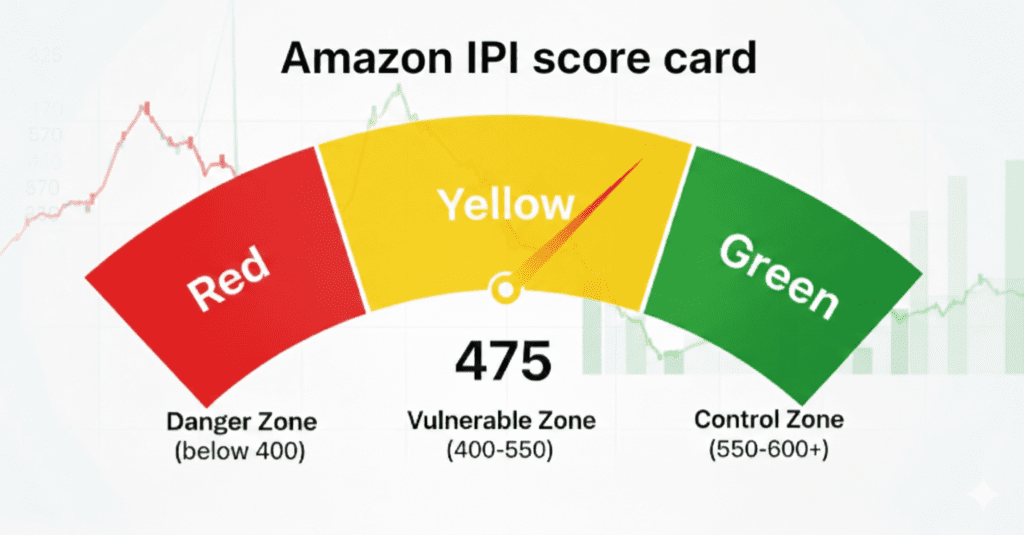
- 400 is survival. 550+ is leverage. Serious operators aim above 550 to protect flexibility and avoid restrictions.
- Velocity matters most. Amazon rewards fast inventory turns and penalizes excess, aging, and stranded stock.
- Capacity cuts cost more than fees. The real damage is lost revenue during peak events and capped bestsellers.
- Discipline wins. Consistent inventory cleanup, strong sell-through, reliable in-stock rates, and smarter replenishment drive stable IPI.
If you have been selling on Amazon FBA for any meaningful length of time, you have likely felt the shift. The Inventory Performance Index, once just another metric buried inside Seller Central, has become one of the most powerful forces shaping your growth.
It determines how much inventory you are allowed to send in. It influences your restock limits at the ASIN level. It affects your exposure to storage surcharges. And perhaps most importantly, it dictates whether you can scale confidently into peak seasons like Prime Day and Q4 or spend those critical weeks fighting capacity restrictions.
That control traces back to a single number.
Need clarity on your marketing data?
See how Market Aspex helps brands scale smarter.
Learn More → Explore all services →In 2026, Amazon has made its position unmistakably clear. The platform is not easing inventory pressure. It is tightening operational standards.
The 400 IPI threshold still stands as the official minimum. But what has changed is enforcement speed and sensitivity. When your score dips below 400 at the wrong moment, the consequences now move quickly. Storage capacity can be reduced within days, often right when you are ramping up inventory for a major sales event. By the time you react, the window may already be closing.
We see this pattern repeatedly across established brands. Sellers who treat IPI as a background metric they will “clean up later” are the same ones forced into reactive decisions before Prime Day or Q4. They discount aggressively, rush removals, and scramble to rebalance inventory under pressure.
On the other side are operators who treat IPI management as part of their core operating system. They review it weekly. They adjust replenishment based on live sell-through. They remove drag before it compounds. Those sellers have room to test, launch, and expand while competitors are navigating restrictions.
This guide breaks down what changed in 2025 and 2026, why those changes matter more than most sellers realize, and the five tactical levers that consistently move your IPI in the right direction.
What Changed in 2025–2026 and Why This Matters?
Over the past year, Amazon did not make one dramatic announcement. Instead, it made a series of calculated adjustments to FBA policy that collectively changed the operating environment.
Here is what materially shifted.
Capacity Forecast Windows Are Shorter
Amazon used to model roughly six months of projected sales coverage when allocating storage capacity. That cushion has narrowed to closer to five months.
One month may not sound significant on paper. In practice, it compresses your margin for error. Recent performance now carries more weight in determining how much space you receive. A slow 30 to 60 day period can meaningfully impact your ability to send inventory during a ramp-up phase.
In other words, historical strength does not protect you the way it once did. Momentum matters more.
Storage Utilization Surcharges Are Hitting Harder
When your inventory volume grows faster than your sell-through, Amazon now responds faster. Especially for bulky, seasonal, or slower-moving products.
Holding inventory inside FBA without the velocity to justify it is no longer neutral. It is expensive. Utilization thresholds trigger surcharges that quietly compress margin, particularly for brands that rely on bulk shipments or long buying cycles.
Long-Term Storage Fees Start Earlier
Aged inventory surcharges now begin at 181 days, with an additional increase at 271 days. Previously, many sellers mentally benchmarked long-term storage at the one-year mark.That cushion is gone.
Inventory that lingers for six months is already entering penalty territory. By nine months, the cost curve steepens further. The financial pressure arrives earlier in the product lifecycle, which means forecasting mistakes compound faster.
ASIN-Level Restock Limits Have Real Consequences
Even if your overall account metrics appear stable, Amazon can now cap individual SKUs when broader inventory health weakens.That means your bestseller, the product driving your ad efficiency and organic ranking, can be restricted because slower items elsewhere in your catalog are dragging down performance.
This is where many sellers feel blindsided. They assume strong demand will protect their top SKUs. It does not. The system evaluates inventory health holistically.
All of these adjustments move in a single direction.Amazon wants velocity. It wants faster turns and less warehousing behavior inside FBA.
What IPI Actually Measures
At its core, the Inventory Performance Index is Amazon’s efficiency scorecard. It runs from 0 to 1000 and reflects how well you manage inventory inside FBA over time.
Amazon does not publish the exact formula. That is intentional. But they do surface the four primary inputs inside Seller Central:
- Excess inventory
- Sell-through rate
- Stranded inventory
- In-stock rate for replenishable ASINs
Taken together, these metrics tell Amazon one simple story: are you operating like a retailer focused on velocity, or like a warehouse renting shelf space?
From Amazon’s perspective, “good behavior” is straightforward.
- Keep your highest demand products in stock.
- Turn units quickly after they arrive at fulfillment centers.
- Avoid sending inventory that will sit idle.
- Do not use FBA as long-term storage.
If your operation consistently aligns with those behaviors, your IPI reflects it. Sellers who run tight, disciplined inventory systems typically sit well above 400. Many operate comfortably in the 550 to 600 range or higher.
And they experience far fewer surprises around storage limits, restock caps, and fee exposure.
What “Healthy” Actually Looks Like
Yes, 400 is the official minimum.But treating 400 as success is like treating break-even as profit. It keeps you alive, but it does not give you leverage.
Most experienced operators think in terms of three practical zones.
Below 400: The Danger Zone
This is where Amazon applies pressure. Storage capacity tightens. Restock limits shrink. The system signals that you need to clean up inventory before expanding.
400 to 550: Above Water, Not Comfortable
You are technically compliant, but vulnerable. One underperforming month can push you into restriction territory. You have limited room for experimentation or aggressive scaling.
550 to 600 and Above: Operational Control
This is where disciplined brands operate. You have breathing room. You can launch new SKUs. You can test demand. You can send inventory ahead of peak events without fearing sudden constraint.The objective is not to cross 400 once and celebrate. The objective is to build an inventory system that keeps you consistently in a range that supports growth.
The Five Levers That Actually Move Your Score
Here is the good news.IPI is not arbitrary. It is behavioral. It responds directly to how you run your inventory operation. When you understand the mechanics, the score becomes predictable.
Amazon has essentially told you what it rewards inside Seller Central. The four visible components are not just diagnostics. They are control points.
If you build disciplined processes around them, your IPI stabilizes. If you ignore them, the system applies pressure.
These five levers consistently move the needle.
1. Aggressively Reduce Excess and Aged Inventory
Excess inventory is one of the fastest ways to weaken your IPI because it signals something Amazon actively discourages. You are using FBA as storage instead of as a high-velocity fulfillment network.
“Excess” simply means you are holding more units than your recent demand justifies. Amazon calculates this based on projected sell-through, not your optimism.
How to Identify It
At minimum, conduct a monthly inventory health audit. Specifically review:
- SKUs with 90 or more days of supply at current velocity
- Units in the 91 to 180 day aging bucket
- Units in the 181 to 270 day range
- Anything over 271 days
- ASINs Amazon flags directly as excess
These are not passive data points. They are active pressure on your IPI.
How to Correct It
Strategic price reductions often outperform slow erosion. Layer in coupons, 7-Day Deals, Prime Exclusive Discounts, or Outlet placements to accelerate velocity.
For SKUs that are strategically irrelevant or clearly underperforming, submit removal or liquidation orders without hesitation. A one-time removal fee is almost always cheaper than months of storage drag and suppressed IPI.
Increase Sell-Through on Slow Movers
Sell-through is velocity over a rolling window, typically 90 days. When sell-through weakens, Amazon interprets it as overstocking relative to demand.The system responds accordingly by tightening space.
Identify the Real Drags
Sort your FBA sell-through data from lowest to highest. Focus on SKUs with meaningful on-hand inventory and poor movement. Those units are weighing down your portfolio average.
Improve from Two Angles
Conversion Optimization
Strengthen product detail pages. Improve primary images. Clarify value in titles and bullets. Enhance A+ content. Fix keyword discoverability so you are visible where buyers are actively searching.Better conversion improves velocity without additional inventory.
Demand Acceleration
Use Sponsored Products and Sponsored Brands strategically to push controlled traffic to underperforming SKUs. Pair advertising with short-term promotions to create velocity spikes that reset inventory health.
You do not need to transform every slow SKU into a bestseller. You need enough movement that your inventory profile reflects efficiency instead of stagnation.
3. Eliminate Stranded Inventory Immediately
Stranded inventory is pure inefficiency. Units are physically inside FBA, accruing storage costs, but they cannot sell.Common causes include listing suppressions, compliance issues, pricing errors, catalog merges, and data inconsistencies.
Build a Weekly Discipline
Review the stranded inventory dashboard at least once per week.
For each ASIN:
- Identify the root cause
- Correct compliance attributes or category data
- Resolve pricing conflicts
- Reactivate listings quickly
If a SKU is permanently blocked or strategically irrelevant, remove or liquidate it. Do not let it sit unresolved for months.
Stranded inventory should be treated like urgent operational tickets, not a backlog to review “when there is time.”
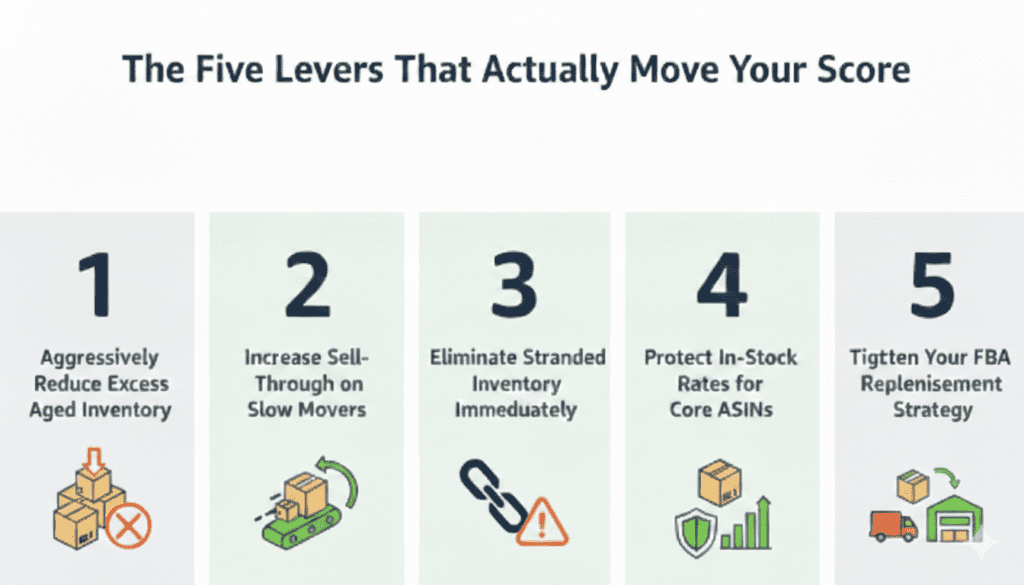
4. Protect In-Stock Rates for Core ASINs
Excess hurts IPI, but repeated stockouts also weaken it. Amazon wants reliability on replenishable products.An unstable in-stock rate signals poor planning.
Prioritize with Intent
Not every SKU deserves equal protection.
Focus on:
- Top revenue drivers
- High-margin contributors
- ASINs with strong organic rank
- Products with efficient advertising performance
- Strategically critical catalog anchors
These are the products that sustain account health and scale.
Build a Real In-Stock Engine
Forecast at the SKU level. Incorporate seasonality, historical trends, and planned marketing pushes.
Set clear reorder points. Establish safety stock based on lead times and volatility.
Align advertising spend with inbound inventory. Driving demand into a pending stockout erodes both performance and IPI.
Amazon’s restock recommendations can serve as a reference point, but your forecasting model should guide final decisions.
Tighten Your FBA Replenishment Strategy
Many IPI problems begin long before inventory is received.
Large, infrequent shipments that represent four to six months of supply may feel operationally efficient. In reality, they often create excess exposure and aging risk.
Shift Toward Continuous Flow
Adopt smaller, more frequent shipments. For most SKUs, aim for 30 to 60 days of supply, adjusted for volatility and supplier lead times.
Use a 3PL strategically when appropriate. Hold bulk inventory outside FBA and feed Amazon based on real demand rather than projected optimism.
Integrate forecasting directly into replenishment planning. Inbound quantities should reflect current velocity, not outdated assumptions.
Over time, this structural shift reduces excess, improves sell-through ratios, stabilizes in-stock performance, and naturally strengthens IPI.
The Bottom Line
Amazon has made it clear that inventory efficiency determines how much room you are given to scale. The 400 threshold still exists, but it functions as a minimum compliance marker, not a strategic target.
When you systematically manage excess inventory, maintain strong sell-through, eliminate stranded units quickly, protect in-stock rates on key ASINs, and align replenishment with real demand, your IPI stabilizes. When your IPI stabilizes,e, scaling becomes intentional rather than reactive.
The sellers who win in this environment are not the ones chasing hacks. They are the ones running disciplined, data-driven inventory systems that align with how Amazon rewards performance.
When IPI Management Becomes Too Complex to Run Internally
For brands doing meaningful volume on Amazon, IPI is rarely the only operational challenge.
You are balancing paid media efficiency, listing optimization, catalog expansion, forecasting, contribution margin analysis, and potentially multiple channels including Walmart, Shopify, or TikTok Shop.
At a certain scale, the cost of fragmented decision-making becomes higher than the cost of specialized expertise.
That is where Market Aspex operates differently.
We do not treat Amazon growth as a collection of disconnected tactics. We build revenue clarity systems that connect inventory performance, advertising efficiency, and financial visibility into one integrated framework.
If your team is spending more time reacting to storage limits and capacity restrictions than executing strategic growth, it may be time to elevate the structure behind the operation.
Explore how Market Aspex can help you clarify your data and scale with confidence.
Frequently Asked Questions
What is a good IPI score on Amazon?
Amazon sets 400 as the minimum threshold, but that is simply the floor. Scores between 400 and 550 leave you exposed to volatility if performance softens.
Most experienced operators aim for 550 to 600 or higher. That range provides buffer for seasonal fluctuations, product launches, and promotional pushes without triggering sudden capacity restrictions.
How often does Amazon update your IPI score?
IPI is recalculated weekly. However, it reflects performance over a rolling time horizon, not just the last few days.This means two things. First, sudden improvements will not instantly spike your score. Second, gradual inefficiencies can accumulate quietly before the consequences appear.
What happens if your IPI drops below 400?
If your score falls below 400 during key evaluation periods, Amazon can reduce your FBA storage capacity and tighten ASIN-level restock limits.
The timing is what hurts most. If the drop happens before Prime Day or Q4, you may be forced to adjust inbound plans quickly, delay shipments, or hold inventory outside FBA. Recovery takes time because the score reflects sustained performance, not short bursts of correction.
Can you recover a low IPI score quickly?
Recovery is rarely instant, but it is absolutely achievable with focused action.Stranded inventory corrections can improve metrics within days.
How does IPI affect FBA storage fees?
IPI does not directly set your storage fees, but it controls your available capacity. Lower capacity increases the likelihood of hitting utilization thresholds that trigger surcharges.A weak IPI often coincides with excess and aging inventory, which leads to long-term storage fees beginning at 181 days and escalating again at 271 days.The financial impact is cumulative. It shows up as compressed margin and slower capital turnover over time.