Search intent is the goal behind a search query: what the person actually wants to learn, find, compare, or do. For SEO in 2026, the practical job is to identify the dominant intent on the live search results page, choose the right page type and format, answer the user’s need early, and make the next step clear. The same principle matters in AI-assisted search, where users can ask longer, more specific questions and explore several related subtopics in one search experience.
- The four useful working categories are informational, navigational, commercial investigation, and transactional intent.
- • A keyword can be relevant to your business and still be a poor target if your page type does not match what searchers expect.
- • Use the live SERP as evidence: review the pages, local results, shopping modules, videos, comparison formats, and other features Google is currently showing.
- • Mixed-intent queries may need hybrid content that educates first and then helps the user compare or act.
- • Google’s people-first guidance supports creating content that helps visitors achieve their goal rather than writing to a fixed word count or repeating keywords.
- • For AI Overviews and AI Mode, Google says standard SEO best practices still apply; there is no separate AI-only optimization requirement.
Why Search Intent Matters More Than Keyword Matching
A keyword tells you what someone typed. Search intent tells you what they expect to happen next.
That distinction changes how an SEO strategy should be built. A service page can contain the exact phrase a prospect searches and still struggle if the results are dominated by educational guides. A long-form blog can be well written and still miss the mark when users clearly want a product category, local provider, calculator, comparison, or login page.
Google’s own guidance reinforces the same broader principle: create helpful, reliable, people-first content that leaves visitors feeling they learned enough to achieve their goal. Google also says it does not have a preferred word count, so intent is a stronger planning signal than simply matching a competitor’s length.
What Is Search Intent?
Search intent, also called user intent or query intent, is the purpose behind a search. In practical SEO work, it answers one question: what result would best help this person complete the task implied by the query?
Most SEO teams use four broad categories. They are useful because each one tends to call for a different page experience, content structure, and call to action.
| Intent | What the Searcher Wants | Typical Query | Best-Fit Page |
| Informational | Learn or solve a problem | how to optimize product pages | Guide, tutorial, explainer |
| Navigational | Reach a known site or page | Amazon Seller Central login | Brand or destination page |
| Commercial investigation | Compare options before deciding | best SEO agency for ecommerce | Comparison, review, service guide |
| Transactional | Take an action now | hire Shopify SEO agency | Service, product, booking, or lead page |
1) Informational Intent: The Searcher Wants an Answer
Informational searches are about learning. The user may want a definition, instructions, troubleshooting help, examples, research, or a clearer explanation of a topic.
• Examples: “what is search intent,” “how to write a meta description,” “why is my website traffic dropping.”
• Best content: guides, tutorials, explainers, checklists, definitions, videos, and original research where appropriate.
2) Navigational Intent: The Searcher Already Knows the Destination
Navigational searches happen when the user already has a brand, platform, website, or specific page in mind. These are usually poor conquest targets because the searcher is not broadly evaluating alternatives.
• Examples: “Google Search Console,” “Market Aspex contact,” “Shopify login.”
• Best content: the official destination page with clear navigation and minimal friction.
3) Commercial Investigation: The Searcher Is Comparing
Commercial intent sits between learning and acting. The user understands the category but has not chosen a provider, product, or approach yet.
• Examples: “best SEO agencies for ecommerce,” “Shopify vs WooCommerce,” “best pond skimmer for 1 acre pond.”
• Best content: comparison pages, buyer guides, alternatives, reviews, case studies, service explainers, and decision frameworks.
4) Transactional Intent: The Searcher Is Ready to Act
Transactional searches indicate that the user is trying to buy, book, request, register, download, or otherwise complete an action.
• Examples: “hire local SEO company,” “buy reusable swim diaper,” “book PPC consultation.”
• Best content: product pages, collections, service pages, location pages, booking pages, lead forms, and other conversion-focused destinations.
Do not select a target keyword based on volume alone. Start with the business outcome, then confirm that the SERP supports a page your brand can credibly create. A high-volume informational keyword can generate less business value than a smaller commercial query if the latter attracts people who are actively comparing solutions.
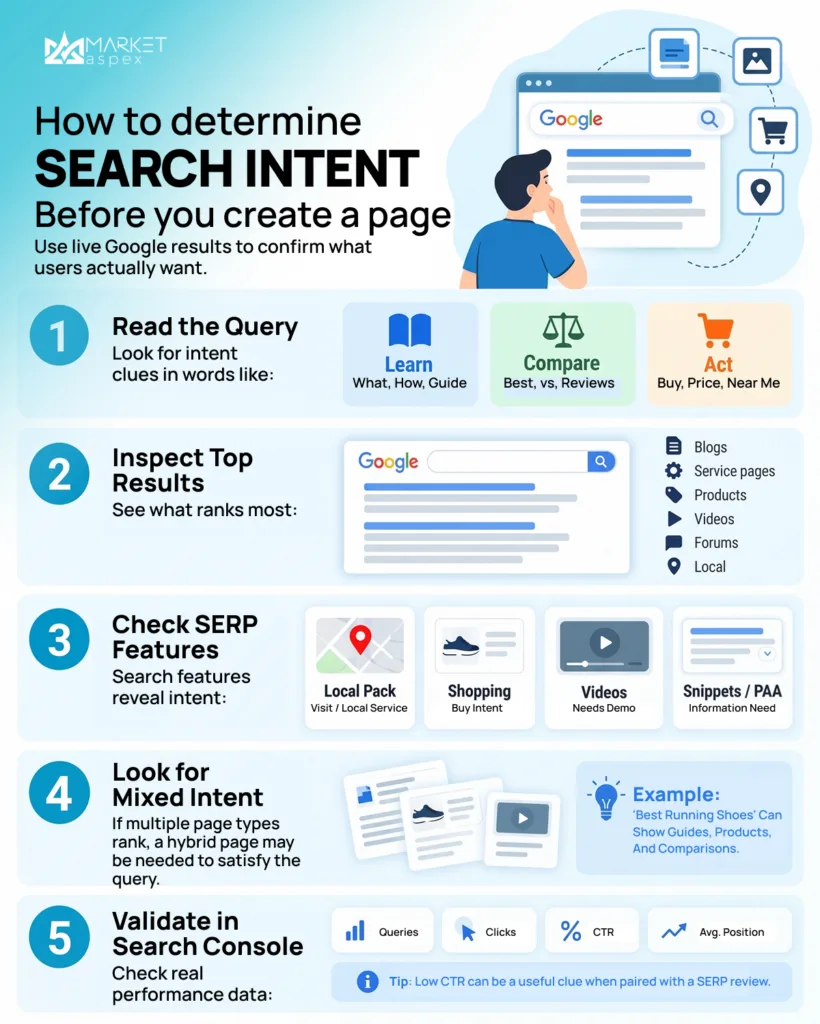
How to Determine Search Intent Before You Create a Page
Keyword tools can label intent, but the live search results page is the stronger final check because it shows what Google is currently choosing to surface for that query.
Step 1: Read the Query Like a Customer
Start with obvious modifiers. Words such as “what,” “how,” and “guide” often suggest learning. “Best,” “vs.,” “reviews,” and “alternatives” often suggest comparison. “Buy,” “price,” “near me,” “book,” or a specific service can indicate stronger action intent. Treat these as clues, not rules.
Step 2: Inspect the Top Results
Look at the first-page result types. Are they blog posts, category pages, service pages, tools, forums, videos, local businesses, product pages, or comparison articles? The dominant pattern is a strong signal of the task Google believes most users want to complete.
Step 3: Check SERP Features
A local pack can indicate local service or visit intent. Shopping results may indicate buying intent. Videos may tell you the query benefits from demonstration. Featured snippets, People Also Ask results, and explanatory modules can signal a strong information need.
Step 4: Look for Mixed Intent
Not every query has one clean purpose. A keyword can return guides, product pages, forums, and service pages at the same time. That usually means different users are arriving with different expectations. A hybrid page may work better than forcing the query into one category.
Step 5: Validate With Your Own Search Console Data
For pages that already receive impressions, use Google Search Console to review queries, clicks, click-through rate, and average position. Low CTR is not proof of an intent mismatch, but it is a useful diagnostic signal when combined with SERP review, title relevance, brand strength, and ranking position.
Match the Page Type, Format, and Angle
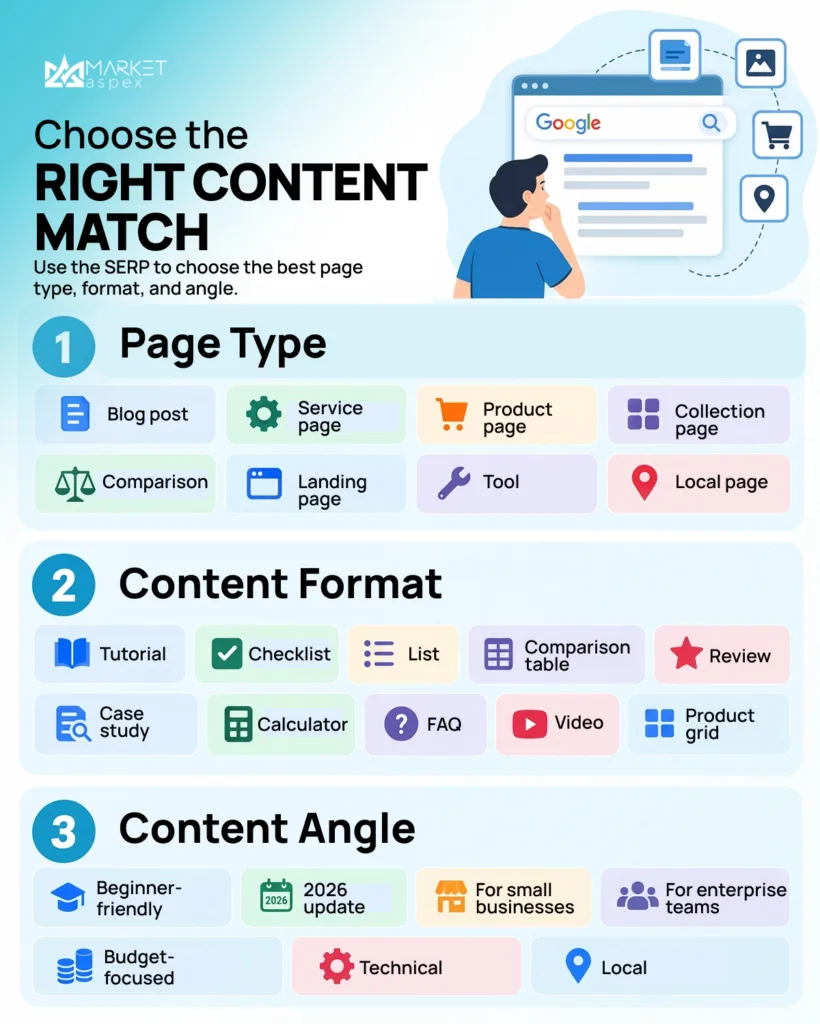
Once you understand the intent, decide what you are actually building. A useful way to think about this is in three layers:
• Page type: blog post, service page, product page, collection page, comparison, landing page, tool, or local page.
• Content format: tutorial, checklist, list, comparison table, review, case study, calculator, FAQ, video, or product grid.
• Content angle: beginner-friendly, 2026 update, for small businesses, for enterprise teams, budget-focused, technical, local, or another specific perspective supported by the SERP and your audience.
The goal is not to clone what already ranks. Google recommends providing original information, analysis, or additional value instead of simply rewriting other sources. Use the SERP to understand the task, then add the expertise, examples, data, visuals, tools, and perspective that make your page genuinely more useful.
Search Intent and the Customer Journey
Intent categories are useful, but real buyers do not always move through a neat funnel. One person might start with an informational question, compare providers five minutes later, and submit a form on the same visit.
That means an SEO content plan should connect intents instead of treating every keyword as an isolated page.
• Informational: “what is Amazon PPC”
• Commercial: “best Amazon PPC agency”
• Transactional: “Amazon PPC management services”
• Navigational: “Market Aspex Amazon services”
Market Aspex already applies this logic in its White Hat SEO framework, which maps keywords to buying intent and revenue impact instead of prioritizing search volume alone.
How Search Intent Changes in AI Search
AI-assisted search makes intent more conversational, but it does not make intent less important.
Google says AI Mode is designed for nuanced questions, further exploration, reasoning, and complex comparisons. AI Overviews and AI Mode may use query fan-out, issuing multiple related searches across subtopics and data sources to build a response.
For content teams, the practical implication is that a page should not only repeat one keyword phrase. It should make the topic easy to understand across the related questions a real user is likely to ask.
• Answer the primary question early.
• Use descriptive headings that map to meaningful subtopics.
• Include specific examples, definitions, comparisons, and decision criteria where useful.
• Keep important facts in visible text, not only in graphics.
• Use internal links to connect the user to the next logical question or action.
Google is also clear that there are no additional technical requirements or special schema needed specifically for AI Overviews or AI Mode. Standard SEO fundamentals, indexability, internal linking, page experience, useful text, and accurate structured data remain relevant.
Search Intent Mistakes That Waste SEO Effort
Choosing Keywords by Search Volume Alone
Volume does not tell you whether the searcher wants the kind of page you can offer or whether the traffic is commercially useful.
Forcing a Blog to Rank for a Service Query
If the SERP is dominated by agencies, service pages, local results, and quote-driven pages, another long-form blog may be the wrong asset.
Using a Product Page for a Research Query
Someone comparing options may need specifications, pros and cons, use cases, compatibility, or a buyer guide before they are ready for a product detail page.
Copying the Current SERP Without Adding Value
SERP analysis tells you the expected task and format. It does not justify producing a near-duplicate of the pages already ranking.
Using the Same CTA on Every Page
A hard sales CTA can feel premature on a beginner explainer. A vague “learn more” CTA can waste high-intent traffic on a pricing or service page.
Treating Intent as Permanent
Search results can change. New products, new SERP features, seasonality, local signals, and changing user behavior can shift the dominant intent. Important pages should be reviewed periodically.
A Practical Search Intent Audit for Existing Content
You do not need to rebuild an entire content library at once. Start with pages where the potential upside is highest.
1. Export high-impression pages and queries from Google Search Console.
2. Flag pages with weak CTR, weak conversions, declining clicks, or rankings that stall below the positions you need.
3. Search the target queries manually and record the dominant page types and SERP features.
4. Compare the current page with the dominant intent: page type, format, angle, answer depth, and CTA.
5. Separate snippet problems from content problems. A weak title may need a targeted rewrite; the wrong page type may require a full rebuild.
6. Prioritize pages by business value and potential impact, not just by traffic.
7. Recheck the page after Google has recrawled it and enough new data has accumulated to make the comparison meaningful.
How Search Intent Should Shape Keyword Research
Keyword research is stronger when intent is mapped before content is assigned. Instead of producing a list of terms and handing them to writers, group keywords into clusters that represent the same underlying task.
For example, “SEO agency Orlando,” “Orlando SEO company,” and “SEO services Orlando” may belong to one commercial or transactional cluster rather than three separate articles. By contrast, “what is SEO,” “how long does SEO take,” and “SEO vs SEM” represent different informational questions and may deserve separate pages.
For a broader decision framework, see Market Aspex’s SEO vs. SEM guide, which explains how search demand and buyer readiness affect channel strategy.
Search Intent Is Also a Conversion Strategy
The value of intent does not end at rankings. It helps determine whether the page attracts the right visitor and whether that visitor sees an appropriate next step.
An informational page can earn visibility and build trust. A commercial page can reduce uncertainty. A transactional page can remove friction. When those pages are internally linked around the same customer problem, SEO becomes a pathway from discovery to decision rather than a collection of isolated rankings.
BUILD CONTENT AROUND WHAT BUYERS ACTUALLY WANT
Market Aspex connects keyword research, search intent, technical SEO, content, and conversion strategy so organic visibility supports measurable business growth.
Explore Market Aspex SEO Services
Aisha | Market Aspex Team
Aisha is an SEO Manager and Content Strategist at Market Aspex with over five years of experience across multiple industries, including real estate, ecommerce, and professional services. She develops data-informed content and SEO strategies that improve search visibility, attract high-intent traffic, and support measurable business growth