SEO and answer engine optimization (AEO) are not competing strategies. SEO builds the technical, content, and authority foundation that helps a page become discoverable in search. AEO is a practical way to think about making that same content easy for AI-powered search experiences and answer engines to understand, retrieve, cite, and recommend. In 2026, brands should optimize one strong search system for both traditional results and AI-generated answers not replace SEO with an “AEO-only” playbook.
- SEO is still the foundation. Google says the same core SEO best practices apply to AI Overviews and AI Mode, with no separate technical requirement for inclusion.
- AEO is best treated as an extension of SEO: clearer answers, better evidence, stronger entity signals, and content that is easy to retrieve and understand.
- There is no special “AI schema” required for Google’s generative search features. Structured data should accurately match visible page content, but it is not a shortcut to citations.
- AI visibility needs its own measurement layer. In 2026, Google Search Console includes dedicated Generative AI performance reporting, while ChatGPT search referrals can be tracked when they reach your site.
- Don’t copy the same question into dozens of thin pages. Google’s current guidance favors unique, non-commodity, people-first content and warns against scaled content created mainly to manipulate search.
- The right resource mix depends on your market. Local businesses, eCommerce brands, and B2B companies will not all have the same balance of classic search demand and AI-assisted research.
Search behavior is no longer limited to a page of blue links. A buyer may compare options in Google AI Mode, read an AI Overview, ask ChatGPT for recommendations, or move between several of those experiences before visiting a website.
That does not make SEO obsolete. Google’s current guidance is explicit that SEO best practices remain the foundation for its generative AI features. OpenAI also says public websites can appear in ChatGPT search and provides specific crawler guidance for publishers that want their content to be discoverable.
If you need a refresher on the broader shift, Market Aspex has already covered why SEO is still relevant in the age of AI. This guide goes one step further and shows how SEO and AEO fit together in 2026.
SEO vs. AEO: What Is the Difference?
SEO (search engine optimization) focuses on making a website accessible, relevant, authoritative, and useful enough to earn visibility in search results.
AEO (answer engine optimization) is a broader industry term for improving the chances that your information is understood and surfaced when an AI-powered system generates a direct answer.
For Google specifically, AEO is not a separate ranking system. Google says terms such as AEO and GEO may be used by the industry, but optimizing for generative AI search is still part of SEO because those experiences depend on Google’s search index and ranking systems.
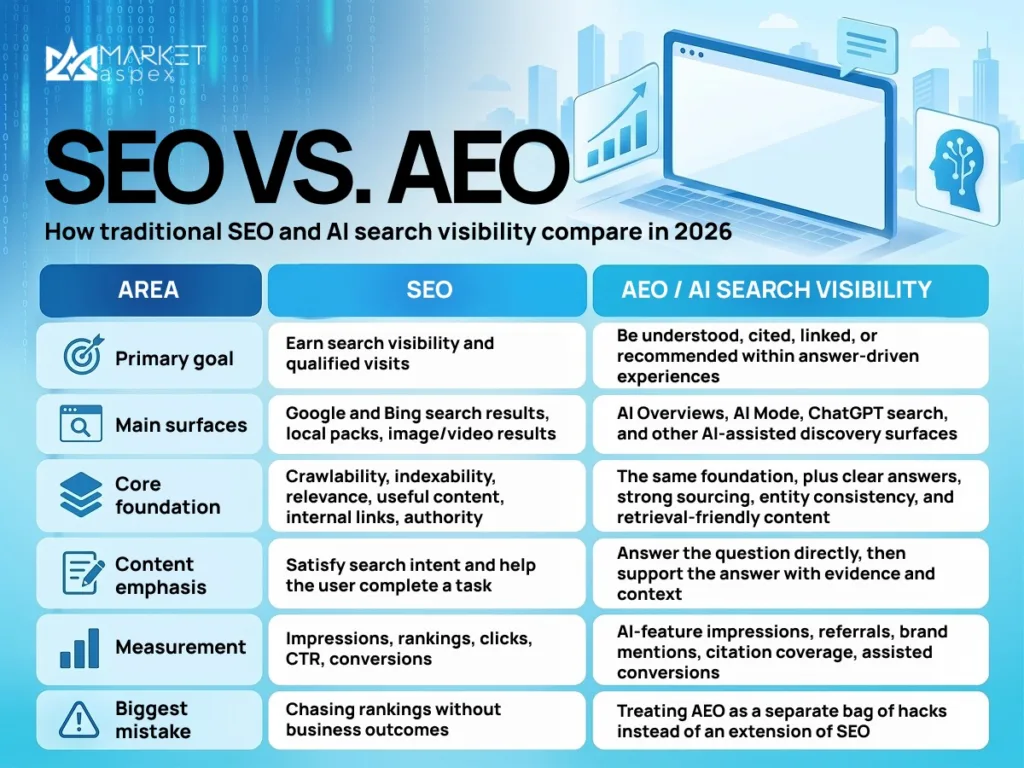
For Google Search, there is no special AEO markup, AI-only schema, or required “llms.txt” file that unlocks visibility in AI Overviews or AI Mode. Google’s 2026 guidance says strong SEO fundamentals, unique content, crawlability, internal linking, useful media, and accurate structured data remain the practical focus.
Why AEO Matters in 2026
AEO matters because more discovery journeys now include generated answers before a user decides whether to click. Google continues to expand generative experiences in Search, while ChatGPT search can return current answers with links to web sources. The website still matters, but the point at which a buyer first encounters your brand may happen inside an answer rather than on your page.
Google’s official guidance explains that AI Overviews and AI Mode can use multiple related searches often described as “query fan-out” to retrieve supporting pages for more complex questions. That creates opportunities for a page to be discovered through related subtopics, not only one exact keyword. See Google’s AI features and website guidance.
ChatGPT search creates another discovery path. OpenAI says any public website can appear in ChatGPT search, and publishers that want their content to be included in summaries and snippets should avoid blocking OAI-SearchBot.
Traditional SEO asks, “Can the right page rank for the right intent?” AEO adds, “Can a search or AI system quickly understand the answer, verify it, and connect it to our brand?” The strongest content should do both.
What SEO and AEO Have in Common
The overlap is bigger than the difference. Most of the work that helps AI visibility is also sound SEO.
1. Crawlability and indexability
If search systems cannot reliably access your pages, they cannot use them. Keep important content available in HTML, avoid accidental blocking, maintain clean canonicals, and resolve indexation problems.
2. Helpful, original content
Google’s 2026 AI-search guidance emphasizes unique, non-commodity content. Original experience, first-party data, clear examples, expert commentary, and useful comparisons give a page more reason to be selected than a generic summary of what everyone else has already said.
3. Search intent
Both classic and AI search need to understand what problem the page solves. One strong page that fully satisfies a clear intent is usually more valuable than a group of overlapping pages built around tiny wording variations.
4. Internal linking and topical structure
Internal links help users and crawlers discover related content. They also make it easier to understand how your service pages, guides, comparisons, and supporting resources fit together.
5. Authority and reputation
Useful mentions, relevant backlinks, credible sources, and consistent brand information still matter. Off-page authority is not replaced by AI search; it becomes part of the wider evidence systems can use to understand your brand.
Market Aspex approaches these pieces as one SEO system from intent mapping and technical foundations to content and authority building. See our White Hat SEO Services for the full framework.
Where AEO Changes the Content Strategy
AEO does not require a second version of every page. It changes how you structure and support the information already on the page.
Lead with the answer
Open important sections with a direct response before expanding into detail. This improves clarity for readers and makes the page easier to interpret programmatically.
Use question-based subheadings when they match real intent
Turn common customer questions into useful H2s and H3s, but do not force every heading into a question. The goal is clarity, not a formula.
Support claims with primary or authoritative sources
When you include statistics, policy details, technical claims, or changing platform guidance, link to the strongest available source and include dates where freshness matters.
Keep brand and entity information consistent
Your company name, services, locations, authors, products, and expertise should be described consistently across your site and trusted external profiles.
Make each section useful on its own
A reader should be able to land in the middle of the article and understand the section without reading three paragraphs of setup. This also makes content easier to reuse in snippets and generated summaries.
Update important pages instead of only publishing new ones
Freshness does not mean changing dates for show. It means revisiting pages when platform rules, pricing, product details, statistics, or best practices materially change.
How to Optimize for SEO and AEO at the Same Time
Use the following workflow instead of treating AEO as a separate campaign.
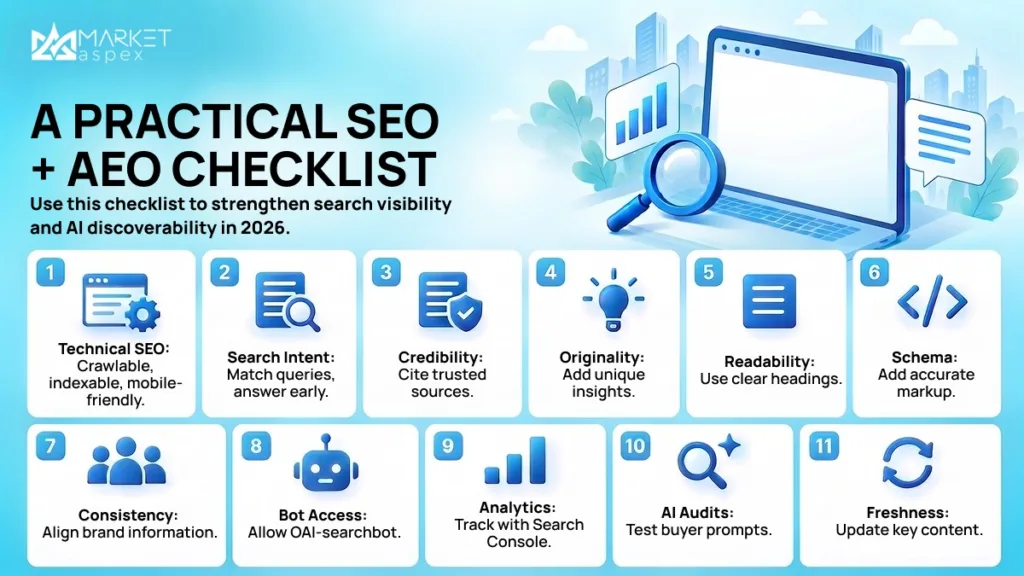
1. Start with technical eligibility. Confirm that priority pages can be crawled, indexed, and displayed with snippets. Fix broken internal links, accidental noindex tags, robots.txt blocks, duplicate page issues, and important content hidden behind rendering problems.
2. Map topics to real buyer questions. Build content around the decisions buyers actually make: cost, comparisons, eligibility, troubleshooting, requirements, alternatives, timelines, and “what should I do next?” questions.
3. Write answer-first sections. Give the direct answer first, then explain the reasoning, caveats, examples, and next steps. Avoid long introductions that delay the useful information.
4. Add evidence competitors cannot easily copy. Use original examples, product data, client patterns, expert quotes, screenshots, tests, case studies, or first-hand observations where appropriate.
5. Build strong internal paths. Link informational content to related guides and relevant service pages. Internal links should help a reader continue the journey, not exist only for SEO.
6. Use structured data accurately. Use supported schema when it genuinely describes the page, and make sure markup matches visible content. Do not expect schema alone to produce AI citations or rankings.
7. Make your site discoverable to the platforms you care about. If ChatGPT search visibility matters, review whether OAI-SearchBot is allowed. OpenAI separates search crawling from GPTBot training controls, so publishers can make different choices for each.
8. Measure and refresh. Review organic performance, AI-feature visibility, referrals, conversions, and prompt-level brand presence. Update high-value pages when the evidence shows a gap.
For location-based businesses, AI search also intersects with local signals, Google Business Profile data, reviews, and consistent business information. See 10 Local SEO Tips to Increase Your Visibility in AI Mode for the local-search side of the strategy.
Does Schema Help With AEO?
Structured data can help search engines understand the entities and content types on a page, but it should not be sold as a direct “AI citation signal.” Google states that there is no special structured data required for AI Overviews or AI Mode. The important requirement is that any structured data you use accurately matches what users can see on the page.
Use schema because it correctly describes your content not because someone promises it will force an AI system to quote you.
How to Measure SEO vs. AEO in 2026
SEO measurement is still centered on search visibility, qualified traffic, and business outcomes. AEO adds a second layer: visibility inside AI-powered discovery surfaces and the downstream demand those surfaces may influence.
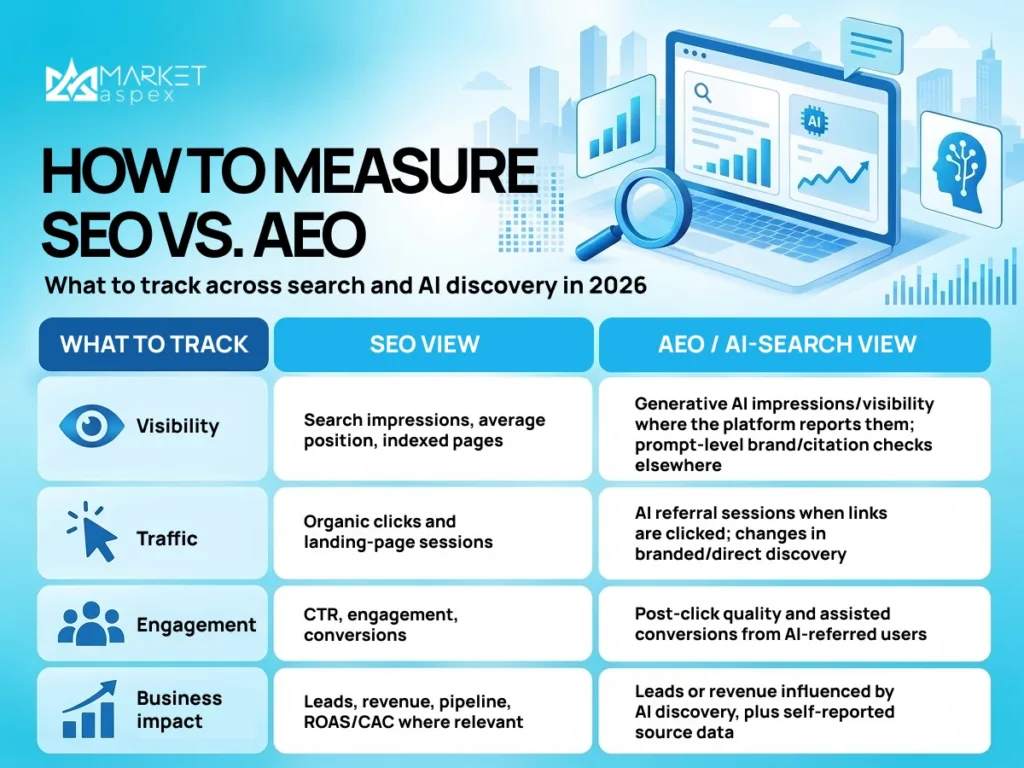
Google added dedicated Generative AI performance reports in Search Console in 2026, giving site owners a clearer view of visibility in AI features on Search. As of August 31, 2026, Google says those insights have rolled out to websites worldwide.
For ChatGPT search, OpenAI says referral links include utm_source=chatgpt.com, which allows inbound traffic from ChatGPT search results to be identified in analytics when a user clicks through.
No measurement stack will capture every AI-assisted discovery journey perfectly. Use a combination of platform reporting, analytics, branded-search trends, self-reported lead source data, and a fixed set of high-value prompts you audit consistently over time.
How Much Should You Invest in SEO vs. AEO?
There is no universal 70/30 or 60/40 budget split that can be defended for every business. A fixed ratio sounds simple, but it ignores where your customers search, how strong your existing SEO foundation is, and what type of demand you are trying to capture.
If your SEO foundation is weak
Prioritize crawlability, indexation, site structure, search intent, content quality, and authority first. AEO cannot compensate for a site that search systems struggle to access or trust.
If you already rank for valuable topics
Layer AI-search improvements onto your highest-value pages: answer-first sections, current sources, stronger expert evidence, better internal linking, and prompt-level measurement.
If you are a local service business
Keep local SEO and Google Business Profile accuracy central. AI-assisted discovery does not remove the importance of maps, reviews, location relevance, and service-area information.
If you sell complex B2B products or services
Invest more heavily in expert-led educational content, comparisons, implementation guidance, and original proof. These are the kinds of questions buyers often research before contacting sales.
If you are an eCommerce brand
Maintain technical SEO and category/product discoverability while improving product data, images, merchant information, buying guides, comparisons, and trustworthy off-site brand signals.
When budget decisions involve both organic and paid search, this Market Aspex guide can help frame the broader channel decision: SEO vs. SEM: The Honest Breakdown for Operators Making Budget Decisions.
Common SEO and AEO Mistakes to Avoid
SEO and AEO work best when they reinforce each other. Many visibility problems happen when businesses chase new AI-search tactics without fixing the fundamentals first or treat AEO like a separate shortcut rather than an extension of a strong SEO strategy.
Common mistakes include:
- Treating AEO as a replacement for SEO. AI visibility still depends heavily on fundamentals such as crawlability, indexation, useful content, authority, and clear site structure.
- Publishing thin pages for every prompt variation. Creating dozens or hundreds of near-duplicate pages usually adds clutter instead of authority. A stronger approach is to build one useful, comprehensive resource that answers related questions clearly.
- Relying on one technical shortcut. Schema, llms.txt, or any single file or markup change will not create AI visibility on its own. Technical signals can help machines understand content, but they do not replace quality, relevance, or trust.
- Using AI only to rewrite existing content. Rephrasing what already exists on the web adds little value. Strong content should contribute original insight, examples, evidence, experience, or a clearer explanation.
- Ignoring crawler access and indexation. Well-formatted content cannot perform if search engines or retrieval systems cannot properly access and understand the page.
- Measuring only rankings and clicks. Traditional SEO metrics still matter, but businesses should also watch AI-feature visibility, branded search trends, referral traffic from AI platforms, citations, and assisted conversions.
- Chasing low-quality mentions for authority. More mentions are not automatically better. Links and references from relevant, trustworthy websites are far more valuable than large numbers of weak or artificial placements.
Authority still requires quality control. If your site has accumulated questionable backlinks or relies on older off-page tactics, review 5 Signs Your Website Needs a Backlink Audit and What to Do About It before investing further in authority building.
A Practical SEO + AEO Checklist
Build One Search Strategy for Both Rankings and AI Visibility
SEO and AEO should not compete for ownership of search. The stronger 2026 strategy is to build pages that search engines can crawl, users want to read, and AI-powered systems can understand and support with confidence.
That means keeping the SEO foundation technical health, intent, content quality, internal links, and authority while making your best pages more direct, evidence-based, current, and measurable across new search surfaces.
READY TO BUILD VISIBILITY ACROSS SEARCH AND AI?
If your website ranks for some searches but rarely appears in AI-assisted discovery, the fix is not to bolt on a separate “AEO campaign.” It is to audit the full search system: technical access, content quality, intent coverage, internal links, authority, entity consistency, and measurement. Market Aspex can help you build that system around qualified demand and revenue
Explore Market Aspex SEO Services

Aisha | Market Aspex Team
Aisha is an SEO Manager and Content Strategist at Market Aspex with over five years of experience across multiple industries, including real estate, ecommerce, and professional services. She develops data-informed content and SEO strategies that improve search visibility, attract high-intent traffic, and support measurable business growth.