Amazon Prime Day 2026 runs June 23 through June 26, four consecutive days that will generate billions in gross merchandise value and create real competitive pressure across virtually every product category on the platform. For shoppers, it is a window to save. For brand operators and Amazon sellers, it is one of the highest-stakes performance periods of the entire year.
Most Prime Day guides tell you what to buy. This one tells you what to watch, what to control, and how to convert event traffic into long-term revenue not just a four-day revenue spike. Whether you manage your own catalog or work with an Amazon account management partner, the decisions you make in the days surrounding Prime Day determine your margin, your rank, and your post-event trajectory.
What Is Amazon Prime Day 2026?
Amazon Prime Day is an annual members-only sales event exclusive to Amazon Prime subscribers. In 2024, the two-day event generated an estimated $14.2 billion in global sales exceeding Black Friday and Cyber Monday combined in single-event Amazon volume. The 2026 edition expands to four full days, reflecting Amazon’s shift toward sustained engagement over a single-day rush.
Need clarity on your marketing data?
See how Market Aspex helps brands scale smarter.
Learn More → Explore all services →| Start DateJune 23, 2026 | End DateJune 26, 2026 | Duration4 Full Days | AccessPrime Members Only |
Prime membership currently costs $14.99 per month or $139 per year in the United States. The global subscriber base exceeds 200 million, and Prime Day access is one of the most frequently cited reasons members maintain their subscriptions. That captive, high-intent audience is exactly why Prime Day matters so much for seller performance and why competition for visibility during the event intensifies sharply.
How Prime Day Deals Work: A Seller’s Lens
From the shopper side, Prime Day runs on urgency. From the seller side, it runs on strategy. There are four core deal types available during the event, and each carries different implications for your catalog and your margins.
Lightning Deals
Time-limited offers that run for a few hours or until inventory is depleted. They appear on the Prime Day deals page and drive disproportionate traffic volume. Sellers must submit Lightning Deals in advance through Seller Central and pay a submission fee. Amazon approves or denies based on review count, star rating, inventory level, and price threshold requirements. Amazon typically requires Lightning Deal submissions two to four weeks before the event.
Prime Exclusive Discounts
A percentage-based markdown visible only to Prime members with no submission fee. Amazon’s algorithm uses this as a competitiveness signal. A well-structured Prime Exclusive Discount measurably improves Buy Box ownership percentage during the event period, and it remains one of the most accessible levers for sellers who missed the Lightning Deal submission window.
Coupons
Clip-to-apply discounts displayed on product detail pages and in search results. Effective at improving click-through rates for mid-funnel shoppers comparing options across multiple ASINs. Coupons can sometimes be stacked with Prime Exclusive Discounts at checkout, creating a compounding discount effect that moves conversion rate.
Sponsored Placements
Premium ad positioning available via Amazon Ads across Sponsored Product, Sponsored Brand, and Sponsored Display campaigns. Cost-per-click rises significantly during Prime Day. Bidding strategy must be recalibrated for event-level competition rather than simply scaled up from your baseline. Brands that carry their standard bids into Prime Day without adjustment typically see ACOS spike and profit erode.
| Seller Intelligence Amazon typically requires Lightning Deal submissions 2–4 weeks before the event. If you missed the submission window for 2026, focus on Prime Exclusive Discounts, coupon strategy, and bid adjustments, there is still significant revenue available through those levers. |
Top Product Categories and What They Mean for Brand Operators
Understanding where Prime Day volume concentrates helps sellers prioritize inventory allocation, advertising budget, and promotional depth. Based on historical Prime Day performance data, these categories consistently lead in both units sold and gross revenue.
Electronics and Gadgets
Historically the dominant Prime Day category. Smartphones, laptops, smart TVs, wireless audio, and gaming hardware see the heaviest discounting and the most competitive ad intensity. If you operate in this space, ACOS management during the event is critical for profitability.
Home and Kitchen Appliances
Air fryers, coffee systems, robot vacuums, and small appliances drive strong conversion rates during Prime Day. Higher average order values improve advertising return on a per-unit basis, making this category particularly attractive for margin-focused sellers.
Beauty and Personal Care
Bundles and subscribe-and-save products perform exceptionally well here. New-to-brand customer acquisition rates in beauty during Prime Day are among the highest across all categories. For brands with a solid repurchase model, this represents a significant LTV opportunity if post-event follow-up is structured correctly.
Health and Fitness
Demand spikes sharply, particularly for wearables, supplements, and workout equipment. Subscription-model fitness products see strong first-purchase conversion when pricing and creative are optimized. Starter bundles and introductory pricing perform well during this window.
Fashion and Apparel
Higher return rates than other categories directly impact net revenue. Sellers should factor return rate into margin projections before committing to aggressive Prime Day discounting in apparel or footwear. The category still generates strong volume, but the unit economics require more careful modeling.
The Five Performance Metrics That Determine Your Prime Day Outcome
Prime Day is not a traffic event. It is a performance event. High traffic with weak conversion, poor inventory positioning, or uncontrolled ad spend will produce a revenue spike that costs more than it returns. These are the five levers that actually determine your outcome:
| Metric / Lever | What Sellers Must Monitor | Revenue Risk If Ignored |
| Ad Spend Efficiency | ACOS, ROAS, TACoS by campaign | Wasted budget on low-intent traffic |
| Inventory Position | Days of stock vs. projected velocity | Stockout = forfeited sales + rank drop |
| Listing Conversion Rate | CVR delta vs. baseline, A/B test data | Clicks without revenue — paid exposure wasted |
| Pricing vs. Competitors | Buy Box ownership %, price elasticity | Losing the Box to a competitor at peak volume |
| Post-Event Attribution | New-to-brand % orders, LTV cohort start | Revenue without a customer relationship to build on |
| Why This Matters for You Brands that track these five metrics in real time during Prime Day are the ones that emerge from the event with improved rank, lower post-event ACOS, and a stronger customer cohort to retarget. Fragmented reporting during peak events is one of the most common revenue leaks. |
For Shoppers: How to Buy Smart During Prime Day 2026
Prime Day rewards preparation. The majority of the most significant deals, particularly Lightning Deals, sell out within minutes of going live. Here is how to approach the event with intention rather than urgency.
- Build your wishlist before June 23: The Amazon wishlist function aggregates your targets in one place and highlights price changes in real time. Set this up at least one week before the event begins.
- Verify actual discount depth before purchasing: Tools like CamelCamelCamel track Amazon price history. Some products are priced upward before Prime Day and discounted back to standard retail. Always check price history before you click.
- Prioritize Lightning Deals early in the day: Amazon surfaces many of its strongest deals in the first hours of each Prime Day session. The early window matters.
- Stack discounts where possible: Prime Exclusive Discounts can sometimes be combined with clipped coupons at checkout. Always check for active coupons on the product detail page before completing your purchase.
- Set a budget ceiling before the event begins:Urgency mechanics are designed to drive impulse volume. The shoppers who benefit most are the ones who have already decided what they need and are executing a list, not browsing.
Mistakes That Cost Sellers and Shoppers Real Money
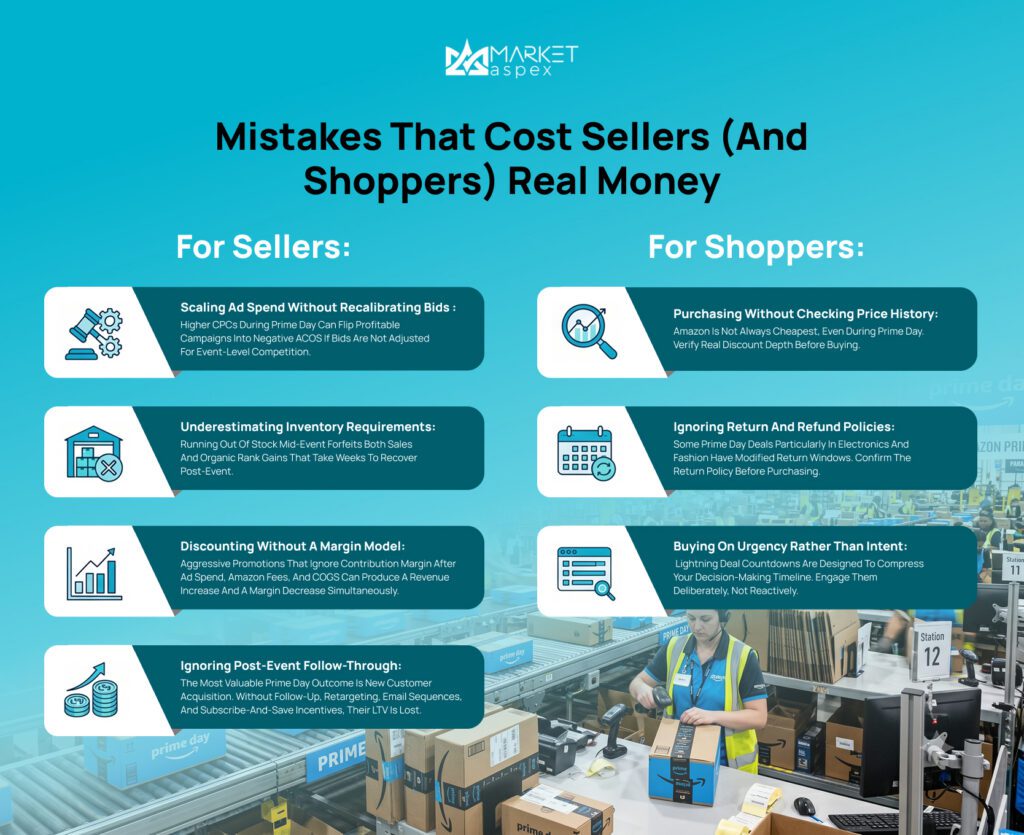
For Sellers:
- Scaling ad spend without recalibrating bids :Higher CPCs during Prime Day can flip profitable campaigns into negative ACOS if bids are not adjusted for event-level competition.
- Underestimating inventory requirements: Running out of stock mid-event forfeits both sales and organic rank gains that take weeks to recover post-event.
- Discounting without a margin model: Aggressive promotions that ignore contribution margin after ad spend, Amazon fees, and COGS can produce a revenue increase and a margin decrease simultaneously.
- Ignoring post-event follow-through:The new customers acquired during Prime Day are the most valuable outcome. Without a structured follow-up strategy, retargeting, email sequences, subscribe-and-save incentives, the LTV of that cohort is left on the table.
For Shoppers:
- Purchasing without checking price history: Amazon is not always cheapest, even during Prime Day. Verify real discount depth before buying.
- Ignoring return and refund policies: Some Prime Day deals particularly in electronics and fashion have modified return windows. Confirm the return policy before purchasing.
- Buying on urgency rather than intent: Lightning Deal countdowns are designed to compress your decision-making timeline. Engage them deliberately, not reactively.
Why Most Brands Leave Prime Day Revenue on the Table
The gap between brands that consistently win on Prime Day and those that see a traffic spike with mediocre returns comes down to one thing: real-time performance visibility paired with a strategy that extends beyond promotions.
The most common pattern identified in Amazon account audits is a brand that drives its highest single-day revenue during Prime Day, then exits the event with a lower organic rank than before, a bloated ad spend ratio, and no clear data on which customers were new-to-brand versus existing buyers. The revenue dashboard looked strong. The business did not actually improve.
Brands that use Prime Day as a compounding growth lever rather than a one-time revenue event are operating with real-time ACOS and TACoS tracking across campaign types, inventory forecasting tied to projected velocity models, conversion rate benchmarking against their own historical baselines, post-event attribution that segments new-to-brand customers for a separate LTV strategy, and a margin model that accounts for fee structure, ad spend, and COGS before promotional depth is set.
| Heading Into Prime Day Without Clear Performance Data? Market Aspex helps Amazon sellers and eCommerce brands build the reporting infrastructure and account strategy that turns peak events into predictable, compounding revenue not one-time spikes. |