TikTok branded content can turn a product demonstration into measurable demand. It can also expose sellers and creators to content removal, reach restrictions, or account penalties when a partnership is not disclosed or a claim crosses the line.
The safest approach is simple: treat every paid, gifted, commissioned, or otherwise incentivized creator post as commercial content. Disclose the relationship, verify every claim, and check the rules for the audience’s country before the content goes live.
This guide explains what TikTok’s branded content rules mean for sellers, marketing teams, and creators in 2026.
If a TikTok post promotes a product because the creator received payment, commission, a free product, a discount, or another benefit, it should be treated as commercial content. The creator must use TikTok’s disclosure setting and follow all applicable branded content, TikTok Shop, advertising, community, and local legal requirements.
- A commercial relationship can include cash, affiliate commission, free products, gifts, discounts, or another incentive.
- Creators promoting a brand, product, or service must turn on TikTok’s Commercial Content Disclosure setting.
- A seller’s own promotional post and a creator’s paid partnership use different disclosure labels inside TikTok.
- Product descriptions, demonstrations, prices, coupons, guarantees, and results must be accurate and current.
- TikTok Shop rules apply to spoken claims, captions, on-screen text, links, props, product demonstrations, and LIVE content.
- Some product categories are prohibited or restricted by country, even when similar content may be allowed as a standard paid ad.
- Sellers need a documented review process because the creator, seller, content, and linked product listing can all affect compliance.
What Is Branded Content on TikTok?
Branded content is content that promotes or reviews a third-party brand, product, or service because a creator has a commercial relationship with that business.
That relationship is broader than a traditional sponsorship. It may include:
· A flat payment for a video or LIVE
· Affiliate commission on TikTok Shop sales
· A free or gifted product
· A discount, trip, service, or other benefit
· An ambassador agreement
· A performance bonus
· A product loan or early access provided in return for exposure
The key question is not whether the creator calls the video an “ad.” The real question is whether something of value influenced the content.
A creator who buys a product independently and shares an honest opinion without any brand relationship may be posting organic content. A creator who receives the same product for free with an expectation of coverage is participating in commercial content and should disclose it.
What Does TikTok Require for Branded Content?
TikTok requires creators to use its Commercial Content Disclosure setting when a post promotes a brand, product, or service. The setting helps viewers understand whether the content promotes the creator’s own business or involves another brand.
TikTok’s current guidance says the disclosure label itself does not reduce recommendation performance. TikTok also states that suspected undisclosed commercial content may become ineligible for the For You feed if the creator does not respond within the provided 24-hour window.
Which Disclosure Should You Select?
The exact interface can change, but TikTok generally distinguishes between:
| Content type | Typical selection | Viewer-facing meaning |
| A business promoting its own product or service | Your brand or promotional content | The account is promoting its own business |
| A creator promoting another company through a commercial relationship | Branded content or paid partnership | The content involves a third-party brand relationship |
The disclosure tool should be used even when the caption also includes terms such as #ad or #sponsored. A hashtag alone should not replace TikTok’s required in-app setting.
For exact steps, review TikTok’s official guide to the Commercial Content Disclosure setting before publishing.
TikTok Branded Content Rules Sellers Cannot Ignore
Disclosure is only the first requirement. The content itself must also comply.
1. Product Claims Must Be Accurate
Creators should only make claims that the seller can support. The promoted product must match the product shown, described, and linked.
High-risk examples include:
· Claiming a skincare product removes acne in a few days
· Presenting an accessory as compatible with a model it does not fit
· Claiming a product has an award or certification without proof
· Showing a result created by editing, a filter, or a different product
· Promising guaranteed results when results vary
TikTok Shop’s current US content rules prohibit false product demonstrations, unsupported certifications, misleading guarantees, and exaggerated performance claims.
2. Price and Discount Claims Must Be Current
A creator can discuss prices, coupons, and discounts, but the offer must be available through the promoted link and any conditions must be clear.
Instead of saying:
“Everyone gets this for $19.99 today.”
Use accurate language such as:
“Eligible shoppers can get the $19.99 price after applying the in-app coupon. Availability and shipping charges may vary.”
The brief should state whether a price depends on a coupon, selected SKU, minimum spend, new-customer status, region, shipping charge, or promotion end date. Avoid “lowest price” and “cheapest anywhere” unless the claim can be verified and remains true.
3. The Product and Content Must Match
The item shown in the video should be the same item connected to the post. Color, size, model, quantity, bundle contents, features, and intended use should be consistent.
This is especially important when sellers reuse creator videos across several similar listings. A high-performing video attached to the wrong SKU can create a compliance issue and a poor customer experience.
4. Intellectual Property Rights Still Apply
Commercial content should not use copyrighted clips, music, logos, celebrity images, or another person’s likeness without the required rights.
Music cleared for personal TikTok use is not automatically cleared for a branded campaign. Sellers should confirm that the creator uses music and visual assets permitted for commercial use.
5. Do Not Manipulate Engagement or Orders
TikTok prohibits content and behavior designed to create fake orders, reviews, views, likes, comments, or followers. Sellers should avoid briefs that require misleading engagement prompts or coordinated activity that creates false popularity.
6. TikTok Shop Content Should Not Redirect Shoppers Off Platform
For TikTok Shop promotional content, off-platform links and calls to action can create problems. TikTok’s US Shop Content Policy says content may be removed when it directs users away from TikTok Shop through website links, email addresses, phone numbers, QR codes, or other external contact information.
This rule is particularly relevant when a brand edits the same creator video for TikTok Shop, Amazon, and its own website. Each version needs a platform-specific call to action.
Prohibited and Restricted Branded Content Categories
TikTok’s global policy and market-specific rules are not identical. A category may be:
· Prohibited in branded content worldwide
· Restricted to adults
· Prohibited only in certain countries
· Allowed in regular TikTok ads but not in creator branded content
· Allowed only after the seller or product receives approval
Common high-risk areas include regulated goods, political content, gambling, tobacco or nicotine products, drugs, certain financial services, medical claims, weight-management claims, products aimed at minors, alcohol, supplements, and selected professional services.
Do not rely on a creator’s past approval as proof that a new campaign is safe. The product, claim, creative treatment, audience, and target country all matter. TikTok’s market-specific branded content requirements should be checked for every market included in the campaign.
| IMPORTANT TikTok’s branded content rules, advertising rules, and TikTok Shop listing rules are separate policy layers. Approval under one policy does not guarantee approval under another. |
TikTok Shop Content Rules That Affect Creator Campaigns
TikTok Shop evaluates more than the caption. Its content policy may apply to:
· Videos and LIVEs
· Cover images
· Titles and descriptions
· Spoken words and voiceovers
· On-screen text
· Product demonstrations
· Clothing, props, gestures, and behavior
· Links and calls to action
For US TikTok Shop content, creators should avoid:
· Exaggerated results or medical cure claims
· Misleading beauty filters
· Unsupported competitor comparisons
· Expired or inaccessible offers
· Products that do not match the linked listing
· Shocking or disturbing promotional treatment
· Static, copied, low-effort, or irrelevant product content
· Attempts to persuade minors to buy or ask a parent to buy
· Unauthorized logos, media, or celebrity likenesses
The current TikTok Shop US Content Policy also explains enforcement and appeal options.
What Happens If Branded Content Is Not Disclosed?
TikTok may notify the original poster when its systems detect commercial content without the correct disclosure. The creator may be able to add the disclosure or appeal if the post is not commercial.
Depending on the rule and severity, possible outcomes include:
· Loss of For You feed eligibility
· Reduced access to promotional or commerce features
· Content removal
· Violation points
· Product or account restrictions
· Suspension from TikTok Shop activity
Repeated violations are usually more damaging than a single corrected mistake. Sellers should keep a record of briefs, approvals, claim support, creator agreements, and final posts so the team can respond quickly if TikTok requests more information.
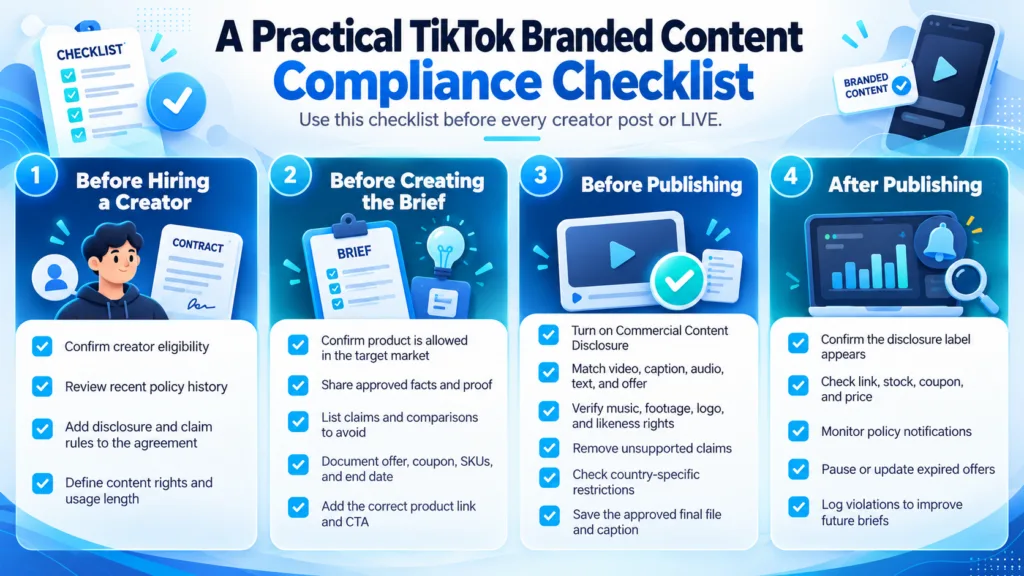
A Practical TikTok Branded Content Compliance Checklist
Use this checklist before every creator post or LIVE.
Before Hiring a Creator
· Confirm the creator is eligible for the required TikTok or TikTok Shop features.
· Check recent content for repeated policy issues, misleading claims, or copied videos.
· Put disclosure, content rights, prohibited claims, and correction duties in the agreement.
· Define where the content can be reused and for how long.
Before Creating the Brief
· Confirm that the product is allowed in the target market.
· List approved facts and provide supporting documents.
· List words, claims, demonstrations, and comparisons the creator must avoid.
· Document the exact offer, coupon terms, eligible SKUs, and end date.
· Provide the correct product link and a platform-specific CTA.
Before Publishing
· Turn on the correct Commercial Content Disclosure setting.
· Confirm that the video, caption, spoken words, text overlays, product link, and offer match.
· Check music, footage, logos, and likeness permissions.
· Remove unsupported health, performance, price, or “best” claims.
· Review the target country’s restrictions.
· Save the approved final file and caption.
After Publishing
· Confirm the disclosure label appears correctly.
· Check the product link, stock, coupon, and price.
· Monitor policy notifications and respond promptly.
· Pause or update content when an offer expires.
· Record violations and use them to improve future briefs.
How Sellers Can Make Creator Content Safer Without Making It Boring
Compliance does not require robotic scripts. Strong creator content can still be specific, useful, and persuasive.
Give creators room to show a real use case while controlling the facts that create risk. An effective brief separates three things:
1. Required facts: Product name, key feature, correct price conditions, disclosure, and approved CTA.
2. Prohibited claims: Medical promises, unsupported comparisons, guarantees, fake urgency, and unverified superlatives.
3. Creative freedom: Hook, setting, personal experience, demonstration style, pacing, and voice.
This structure protects the seller without stripping away the creator’s personality. It also produces content that feels native to TikTok instead of reading like a product listing.
Build a TikTok Strategy That Connects Content, Commerce, and Measurement
Policy compliance protects the account. It does not create a growth strategy on its own.
Market Aspex helps ecommerce brands connect TikTok creative with paid media, social content, marketplace operations, and performance measurement. Our team can help you build creator briefs, manage campaigns, develop TikTok ads, and align social commerce with your wider Amazon and ecommerce goals.
Explore Market Aspex social media management services or schedule a conversation with our team to review your next campaign.

Aisha | Market Aspex Team
Aisha is an SEO Manager and Content Strategist at Market Aspex with over five years of experience across multiple industries, including real estate, ecommerce, and professional services. She develops data-informed content and SEO strategies that improve search visibility, attract high-intent traffic, and support measurable business growth.