Key Takeaways
- Amazon’s new AI prompts act like an automated product assistant, answering shopper questions directly within your ads.
- Any errors, inconsistencies, or outdated details in your listings or Brand Store will be amplified by AI, making content accuracy essential.
- Prompts work well for simple, high-converting products but complex, regulated, or premium items may benefit from opting out once controls are available.
- Amazon will likely monetize prompts after the beta period, so tracking their true impact now is critical for future budgeting and strategy.
- Strong source content leads to accurate AI responses, while weak or incomplete content risks misleading prompts and wasted ad spend.
Generative AI is reshaping online shopping. Instead of searching through listings, customers now ask questions directly to AI tools like ChatGPT, Google AI Overviews, Perplexity, and Amazon’s own assistant technologies.
To keep up, Amazon introduced a major change to Sponsored Products and Sponsored Brands campaigns: AI-generated prompts that automatically answer shopper questions in real time. Every seller was enrolled by default.
This update marks one of Amazon’s biggest shifts in years. Instead of relying only on listing content and manual ad optimization, advertisers must now account for how AI interprets and presents their product information.
Need clarity on your marketing data?
See how Market Aspex helps brands scale smarter.
Learn More → Explore all services →Here’s what the new AI system means, how it works, and what sellers need to fix to avoid inaccurate or harmful AI-generated messages.
What Are Amazon’s New AI Prompts?
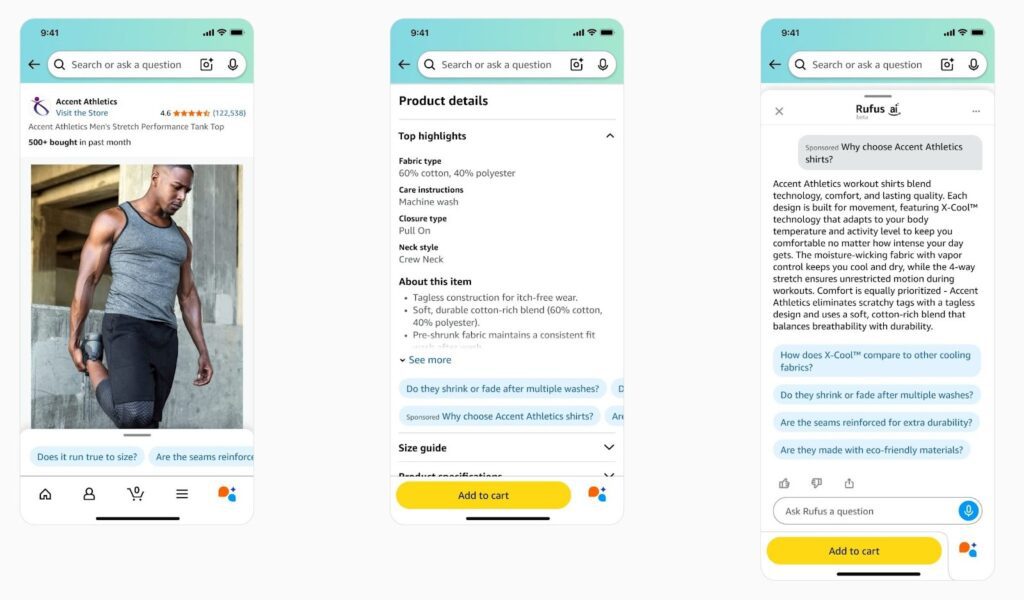
Amazon’s AI prompts are short, conversational answers that appear beside ad placements. Their goal is to remove friction that slows buying decisions. For example, if a shopper hesitates because they’re unsure about sizing, materials, compatibility, or features, a prompt may appear to answer the question instantly.
These responses are:
- Automatically generated
- Pulled from your product listing and Brand Store
- Inserted into your Sponsored Products or Sponsored Brands ads
- Displayed only when Amazon detects buyer uncertainty
It’s essentially an always-on product assistant that jumps in at key moments during the buying journey, giving customers the exact details they need while they’re comparing options. Rolled out in November 2025 and continuing into 2026, this feature was automatically enabled for all eligible U.S. advertisers at no extra cost during the beta phase.
Sponsored Product prompts image source : Amazon
How Amazon Creates AI Prompt Responses
Amazon’s AI synthesizes data from four main sources:
1. Your product detail pages
Titles, bullet points, descriptions, specs, attributes, and A+ content are the foundation.
2. Your Brand Store
Category pages, brand messaging, and comparison charts provide structure and additional context.
3. Your campaign data
Conversion patterns show which product features matter most to shoppers.
4. Amazon’s behavioral insights
Search patterns, browsing flows, and purchase signals tell the AI what typical customers want to know before buying.
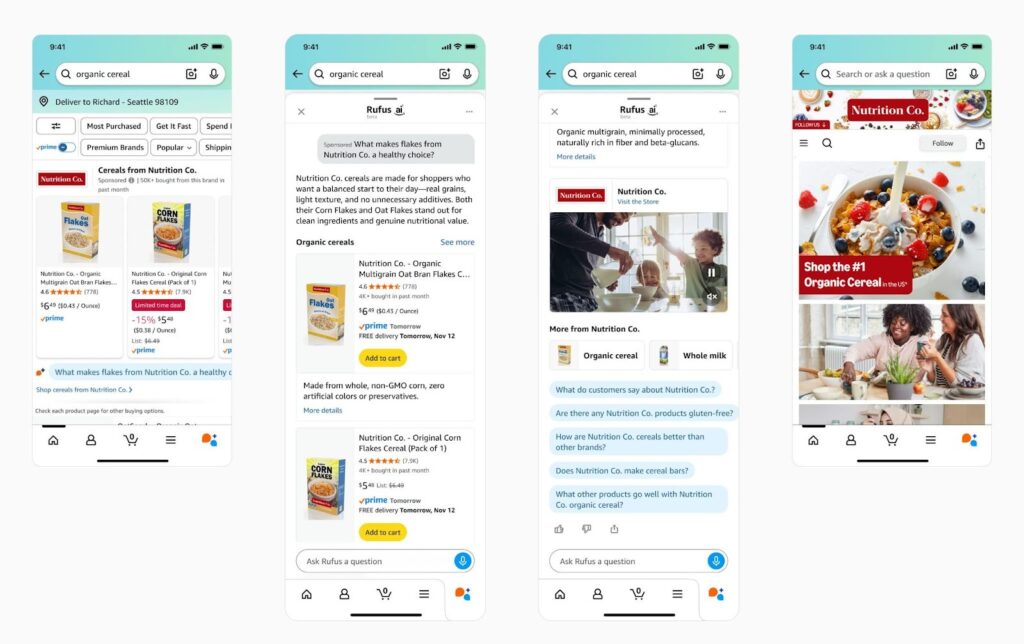
This means anything unclear or inaccurate in your content becomes unclear or inaccurate in your prompts.
Sponsored Brand prompts Image Source : Amazon
Why Amazon Built This Feature
Everything Amazon does centers around one goal: removing barriers to purchase.
AI prompts help shoppers get instant answers instead of leaving the results page to investigate. Amazon’s theory is simple:
Faster answers = fewer abandoned carts = more conversions.
During the free beta, Amazon is testing which prompt styles actually increase orders and which create empty clicks.
Where to View Prompt Performance Data?
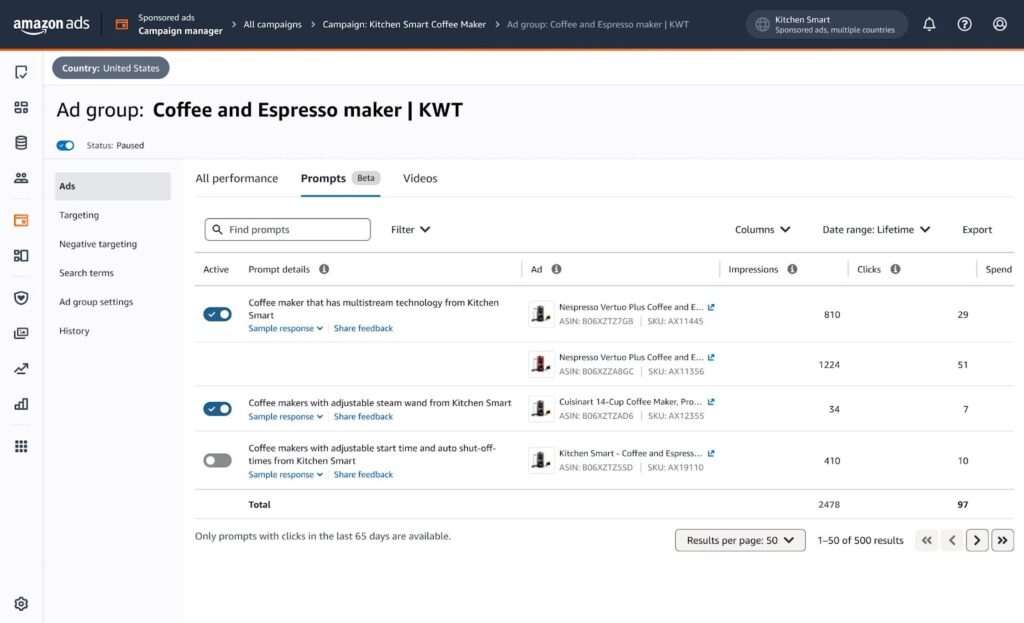
Prompt reporting is available in the Amazon Ads Console:
Campaign → Ad Group → Ads → Prompts Tab
You’ll see:
- Prompt text: The actual AI-generated message shoppers saw.
- Associated ad: The specific product ad that triggered that prompt.
- Performance metrics: Impressions, clicks, CTR, orders, and ACOS tied directly to prompt-driven interactions.
Prompts only appear in reporting once they receive at least one click. API and report integrations will expand through 2026.
Reporting image source : Amazon
How Should I Prepare My Amazon Content for Prompts?
Because Amazon’s AI builds prompts directly from your product listings and Brand Store, the accuracy and quality of your content will determine how well these prompts represent your products. Before prompts start appearing at scale, sellers should run a full content audit.
Start with your product detail pages
Your detail page is the primary source Amazon uses to generate answers. The AI pulls from your titles, bullets, descriptions, specs, and attributes so this content must be complete and correct.
Check for completeness:
Make sure all technical specs are filled out, bullet points answer common shopper questions, your description provides enough depth, and variations or attributes are clearly defined.
Fix inconsistencies:
Confirm your title, bullets, and description all tell the same story. Measurements, features, and claims should match everywhere. Your A+ Content should support, not contradict, the main listing.
Remove outdated information:
Delete anything no longer true like old promotions, discontinued variations, outdated specs, or expired claims. If it’s still on the page, the AI may repeat it.
Correct errors immediately:
Typos, incorrect measurements, and grammar issues can directly influence what the AI says. If something is wrong in your listing, it could become wrong in your prompt.
Review your Brand Store the same way
Amazon’s AI can pull information from any page in your Brand Store, not just your listings. That means old content, outdated charts, or inconsistent messaging can all surface in prompts.
Update comparisons and category pages:
Ensure your comparison charts reflect your current catalog, and category pages only include relevant, in-stock products.
Keep messaging consistent:
Your Brand Store should reinforce the same positioning you want reflected in your AI prompts.
Match Store content to your listings:
Descriptions and product details in the Store should line up exactly with what appears on your detail pages.
Remove seasonal or outdated pages:
Delete expired holiday messaging, old sale references, temporary price mentions, and past product launch announcements.
Risks of AI-Generated Prompts
While prompts may increase conversions, sellers must understand the risks:
1. You lose message control
You cannot edit or preview the text generated on your behalf.
2. Misstatements may occur
If your listing isn’t perfect, AI may misrepresent important features.
3. Low-quality listing content gets amplified
Amazon’s AI repeats whatever it finds good or bad.
4. Future costs are unknown
The feature is free during beta.Once performance is proven, Amazon may raise CPCs or create new pricing.
5. ACOS could increase
If prompts generate curiosity clicks that don’t convert, spend rises without ROI.
When You Should Opt Out
AI prompts won’t be a perfect fit for every product. In some cases, the risks of inaccurate or oversimplified AI responses may outweigh the benefits.
Opt out if your product is:
Highly technical
Products with complex specs like electronics, machinery parts, or compatibility-dependent items can easily be misrepresented if the AI oversimplifies or misunderstands key details. One incorrect claim could lead to returns, negative reviews, or compliance issues.
In a strict compliance category (supplements, cosmetics, etc.)
Categories with regulated claims require careful, controlled language. AI prompts may unintentionally imply benefits or make statements that violate Amazon’s rules, FDA guidance, or other regulatory standards.
Premium or luxury with controlled messaging
High-end brands rely on specific tone, positioning, and wording. AI prompts may dilute that messaging or present the product in a way that doesn’t match your brand voice or value perception.
Already at a fragile ACOS
If your margins are tight, extra clicks that don’t convert can quickly push ACOS into unprofitable territory. Until you see real data showing prompts improve efficiency, it’s safer to stay cautious.
Complex enough that oversimplification could hurt conversions
Products with nuanced features, layered benefits, or multi-step use cases can be misunderstood by AI. If a shopper receives an answer that’s “mostly correct” but misses critical nuance, it can lead to confusion and lower conversion rates.
When You Should Keep Prompts Enabled
Prompts can be helpful for simple products where shoppers mostly need quick clarifications, and where the listing content is already strong.
Keep prompts on if your product:
Is simple and easy to explain
Items with straightforward specs or single-purpose functionality like basic accessories, home goods, or apparel tend to work well because shoppers’ questions are predictable.
Already converts well
If your ads have strong performance and clean content, prompts may give a small, incremental lift by reducing hesitation or answering common questions mid-search.
Has a complete, accurate, well-structured listing
When your titles, bullets, descriptions, and brand store content are tight and informative, the AI has everything it needs to generate helpful, accurate prompts.
Benefits from answering common objections quickly
If shoppers frequently compare alternatives or pause over a few key features (materials, sizing, fit, compatibility), prompts can resolve these barriers faster and reduce friction in the buying journey.
FAQs
Do prompts cost extra during beta?
No. During the beta period, prompts don’t add any new fees. You pay your normal cost-per-click (CPC) whether a shopper clicks on your standard ad or an AI-generated prompt. Amazon is using this phase to test how well prompts influence conversions before deciding on long-term pricing. Once beta ends, costs may change, so it’s important to track performance now.
Can sellers write their own prompt text?
No. Sellers can’t write, edit, or approve any of the AI-generated responses. Amazon’s system automatically pulls information from your product listings, A+ Content, Brand Store, and campaign data to generate prompt text. You’ll only see the exact wording after it receives at least one click, which makes it crucial to ensure your content is complete and accurate.
Which ad types support prompts?
AI prompts currently apply only to Sponsored Products and Sponsored Brands campaigns. Other ad types such as Sponsored Display and Amazon DSP are not included in the feature. Authors and publishers are also excluded from the prompts program, even if they run Sponsored Products campaigns.
Do prompts appear on all ads?
No. Prompts are not guaranteed to appear with every impression. Amazon uses shopper behavior, query intent, and product relevance signals to decide whether showing a prompt could help move a customer closer to purchase. If the system believes additional information could clarify a feature, reduce hesitation, or answer a common question, a prompt may be shown otherwise, the ad appears normally.
Can prompts hurt performance?
Yes. Although prompts can improve conversions when they provide helpful clarification, they can also cause problems if they misrepresent a product or attract low-intent clicks. If your listing content is incomplete or outdated, the AI may generate inaccurate or misleading responses, which can drive returns, negative reviews, or wasted ad spend. Monitoring prompt-specific metrics is essential to determine whether they’re helping or hurting your ACOS.
Need Expert Help Preparing for Amazon’s AI Shift?
AI-driven advertising will only grow more important in 2026. If your listings, Brand Store, or PPC structure aren’t ready, prompts may harm performance instead of helping it.
Market Aspex helps brands:
- Optimize listings for AI
- Prepare content so AI prompts are accurate
- Reduce ACOS and improve conversion rates
- Protect profitability as Amazon introduces new AI-driven ad features
Schedule a strategy session with Market Aspex to strengthen your Amazon advertising for the AI era.