Key Takeaways
- The Amazon Featured Offer still drives the majority of conversions. Losing it on your own listings directly impacts revenue.
- Total landed price matters more than list price, and Amazon’s pricing tolerance has tightened significantly.
- Fulfillment speed is now weighted regionally. Fast delivery to major population centers outperforms national averages.
- FBA is no longer the only path. Strong FBM and Seller Fulfilled Prime operations can compete when execution is tight.
- Account health metrics act as hard eligibility gates. Missing thresholds almost guarantees Featured Offer loss.
- Winning the Featured Offer is not a tactic. It is the outcome of aligned pricing, fulfillment, trust, and data visibility.
If you’re not winning the Amazon Featured Offer on your own listings, you’re effectively paying rent on revenue you should control.
We see this constantly when auditing Amazon accounts for growing brands: strong products, healthy demand, but sales bleeding to third-party sellers and unauthorized resellers because the business is operating on outdated assumptions about how Amazon actually rewards sellers in 2026.
Amazon officially calls it the Featured Offer (yes, it’s still labeled “Buy Box” in many reports), and the logic behind it has evolved. Pricing, delivery speed, regional coverage, and seller authority now work together and missing just one lever can quietly cap your revenue.
Need clarity on your marketing data?
See how Market Aspex helps brands scale smarter.
Learn More → Explore all services →What Is the Amazon Featured Offer and Why It Drives Revenue?
The Featured Offer is the primary purchase module on an Amazon product detail page on the right side with “Add to Cart” and “Buy Now “buttons. When a shopper clicks either button, Amazon routes the sale to the seller holding that position.
That’s the entire game.
For most listings, the majority of conversions flow through the Featured Offer, not secondary seller options. If you’re sharing a listing and losing that placement, your demand is being monetized by someone else.
Amazon assigns the Featured Offer dynamically. Sometimes it rotates among qualified sellers. Sometimes it favors a single seller who consistently outperforms across metrics.
Understanding why each scenario happens is where most brands fall short.
How to Check Your Featured Offer Eligibility
Your Featured Offer eligibility is not hidden, but it is spread across a few different places in Seller Central. What you see can vary by account type and category, which is why relying on just one screen often leads to confusion.
The most reliable places to check are:
- Manage Inventory and the Featured Offer Eligible column
- Account Health dashboards
- Featured Offer eligibility reports
Here is the key distinction to keep in mind:
- Eligible but not winning usually points to a pricing, fulfillment, or competitive issue
- Not eligible almost always means an account health or trust threshold is holding you back
At Market Aspex, we look at this like a diagnostic, not a quick fix. Instead of guessing or reacting to surface-level signals, we trace eligibility and win-rate issues back to the specific metrics and competitive dynamics that are actually limiting your revenue.
The 5 Factors That Actually Determine Featured Offer Eligibility in 2026
1. Total Landed Price (Not Just What You Charge)
When it comes to Amazon Featured Offer eligibility, Amazon does not look at your product price alone. The algorithm evaluates total landed price, which includes your item price plus shipping. This is one of the most common reasons brands lose the Buy Box in 2026 without realizing why.
Over the last 12 to 18 months, Amazon has significantly narrowed the acceptable pricing range for Buy Box and Featured Offer rotation. In the past, sellers could price several percentage points above the lowest offer and still maintain Buy Box share. That margin has compressed. If your total landed price is not competitive with the lowest qualified Amazon offer, your Featured Offer visibility will be limited, regardless of how strong your fulfillment speed or account health metrics are.
This does not mean you need to be the cheapest seller on Amazon. It means your pricing must fall within a much tighter Buy Box pricing window than it did previously. Brands should be monitoring their pricing relative to the lowest landed price, not just the lowest list price displayed on the product page.
Another critical factor is Amazon unfair pricing suppression. Amazon has become far more aggressive about removing Buy Box eligibility entirely when pricing appears inconsistent, inflated, or anomalous. We frequently see listings lose the Featured Offer even when there is only one seller, simply because pricing signals trigger Amazon’s trust and compliance systems.
2. Fulfillment Speed and Prime Eligibility for Amazon Buy Box Wins
Using Fulfillment by Amazon (FBA) is still one of the most reliable ways to qualify for the Amazon Featured Offer. Amazon trusts its own fulfillment network, and that trust shows up as algorithmic preference when Buy Box decisions are made.
What has changed is how competitive FBM and Seller Fulfilled Prime (SFP) have become. In 2026, high-performing FBM sellers are winning Buy Box and Featured Offer share at rates we simply did not see a few years ago. If your seller-fulfilled operation can consistently deliver one- to two-day shipping, maintain strong tracking compliance, and keep defect rates low, you can compete directly with FBA offers.
The real shift is regional delivery speed. Amazon now evaluates where you can deliver quickly, not just your overall average shipping time. An FBM seller offering one-day delivery in major metro areas can outperform an FBA seller whose inventory is concentrated in a single, distant fulfillment center.
Operator takeaway:
- If you run FBM, audit delivery speed by region, not just nationally
- If you run FBA, review inventory placement and distribution coverage
In today’s Buy Box algorithm, population-weighted delivery speed matters more than it ever has.
3. Account Health Metrics That Influence Eligibility
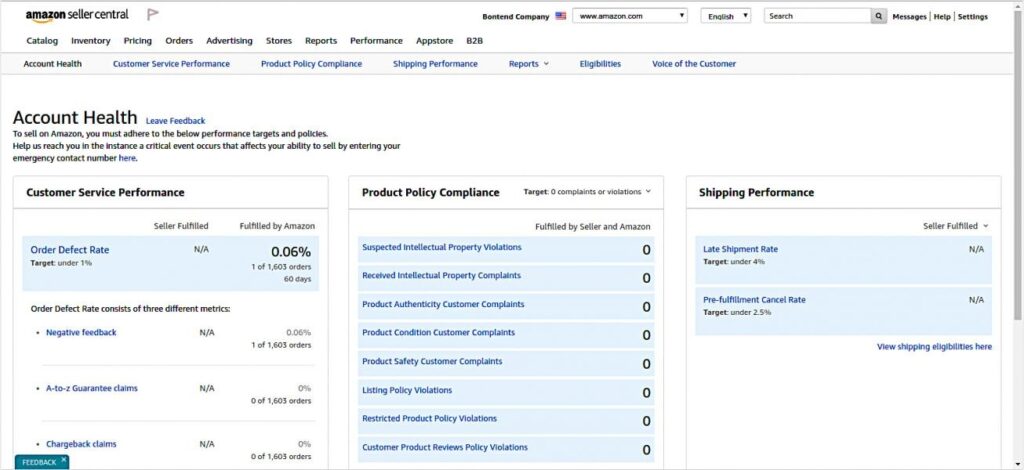
Amazon account health metrics function as both Featured Offer eligibility gates and Buy Box ranking signals. Falling below these thresholds often leads to immediate Featured Offer loss and can trigger broader account-level consequences.
The most important Amazon account health metrics include:
- Order Defect Rate (ODR)
Keep this under 1 percent. ODR includes negative feedback, A-to-Z claims, and chargebacks. This is the most critical metric for Buy Box eligibility. - Late Shipment Rate (LSR)
- Maintain under 4 percent for seller-fulfilled orders. This measures orders shipped after the expected ship date.
- Pre-Fulfillment Cancel Rate
Keep this under 2.5 percent. High cancellation rates signal inventory or listing accuracy issues. - Valid Tracking Rate (VTR)
Target at least 95 percent. Amazon relies on tracking data to evaluate delivery performance. - On-Time Delivery Rate (OTDR)
Introduced as a core metric in 2024. The minimum threshold is generally 90 percent, but brands aiming for strong Featured Offer rotation should target 97 percent or higher. - Customer Response Time
While no longer emphasized as a standalone metric, responding to customer inquiries within 24 hours continues to support overall account health and trust signals.
Meeting these thresholds does not guarantee Buy Box or Featured Offer dominance. Missing them, however, almost guarantees exclusion.
4. Seller Authority and Amazon Trust Signals
Seller authority is one of the most underestimated factors in Amazon Buy Box performance.
Amazon increasingly weighs:
- Seller account tenure
- Feedback volume and consistency
- Historical return rates and defect patterns
Newer sellers with limited history often struggle to win Featured Offer share, even when pricing is competitive and shipping is fast. The algorithm naturally hedges against unknown quantities.
For established brands managing their own listings, this typically works in your favor. Your seller history becomes a defensive moat against unauthorized resellers and short-lived accounts.
In 2026, we are seeing Amazon place greater emphasis on these softer trust signals, with more Featured Offer rotation among similarly qualified sellers instead of long-term winner-take-all allocation.
5. Listing Quality, Conversion Rate, and Buy Box Performance
Listing content does not directly feed the Amazon Featured Offer algorithm, but it strongly influences conversion rate, and conversion rate influences how Amazon values your offer over time.
Strong conversion signals include:
- Clear, mobile-optimized product images
- Accurate, benefit-driven product descriptions
- Focused A+ Content that removes purchase friction
When a listing converts well, Amazon interprets that as customer preference. Over time, that preference shows up in how the algorithm treats your Buy Box and Featured Offer eligibility.
This is an indirect lever. You will not fix Buy Box issues with better images alone. But weak conversion performance can quietly undermine otherwise strong pricing, fulfillment, and account health metrics.
Optimize for mobile-first clarity, make sure your primary image stack tells the product story quickly, and use A+ Content to address hesitation before it turns into abandonment.
What Has Changed in the Last 12 Months
If you are still operating from older Amazon playbooks, these are the updates that matter most in 2026.
- Tighter Buy Box pricing tolerance
The competitive window around the lowest total landed price has narrowed. Amazon pricing optimization now requires far more precision than it did even a year ago. - More Featured Offer rotation
Amazon is distributing Featured Offer placement more evenly among qualified sellers instead of allowing one dominant offer to hold the position indefinitely. - Regional delivery speed matters more
Fast delivery to major population centers now outweighs national average delivery time when Amazon evaluates fulfillment performance. - Stronger seller authority weighting
Seller tenure, feedback volume, and historical return behavior carry more influence in Featured Offer eligibility decisions. - Increased FBM competitiveness
Well-run FBM operations with regional speed advantages can now win Featured Offer share that was previously dominated by FBA-only sellers.
These changes reward brands that operate with clean data, strong systems, and visibility into what Amazon is actually measuring.
Final thoughts :
Winning the Amazon Featured Offer is not the goal. It is the outcome of running a disciplined operation with competitive pricing, fast and reliable fulfillment, clean account health, and a seller history Amazon trusts.
If you are losing Featured Offer share on your own listings, the root cause is almost always one of those levers. Identify what is dragging performance down, fix it systematically, and the Featured Offer follows.
At Market Aspex, we help brands do exactly that. We audit pricing, fulfillment coverage, account health metrics, and competitive dynamics to pinpoint what is actually suppressing Amazon revenue and what can be corrected without guesswork.
Explore how Market Aspex can help you clarify your Amazon data, protect your margins, and scale with confidence.
Frequently Asked Questions
What is the difference between the Featured Offer and the Buy Box?
They are the same thing. Amazon has officially rebranded the Buy Box as the Featured Offer in its documentation, but you will still see “Buy Box” referenced throughout Seller Central, third-party tools, and industry conversations. Both terms refer to the primary Add to Cart placement on the product detail page.
Can I win the Featured Offer without using FBA?
Yes. Seller Fulfilled Prime and high-performing FBM sellers can win Featured Offer placement when delivery speed, tracking compliance, and account health metrics meet or exceed FBA benchmarks. Amazon prioritizes customer experience outcomes, not fulfillment method alone. If you can reliably deliver one- to two-day shipping in major regions, you can compete.
How long does it take to become Featured Offer eligible?
New professional seller accounts typically need time to build sales history and establish consistent account health metrics. This can take several weeks to a few months depending on category and order volume. Meeting minimum thresholds does not guarantee immediate eligibility. Amazon also evaluates seller authority and historical performance.
Why am I Featured Offer eligible but not winning it?
Eligibility means you have cleared the minimum requirements. Winning the Featured Offer depends on how your offer compares to other eligible sellers across pricing, fulfillment speed, and account health. When multiple sellers qualify, Amazon rotates placement based on relative performance. Start by comparing your total landed price and delivery speed in major regions.
Does A+ Content affect Featured Offer eligibility?
Not directly. A+ Content influences conversion rate, which can indirectly affect how Amazon evaluates your offer over time. Strong conversion signals indicate customer preference, which can improve Featured Offer performance at the margin. However, A+ Content will not compensate for pricing or account health issues.
What happens if my metrics fall below Amazon’s thresholds?
Dropping below account health floors, such as Order Defect Rate above 1 percent or Valid Tracking Rate below 95 percent, often results in immediate Featured Offer loss. In more serious cases, listings can be suppressed or accounts restricted. Recovery requires improving the flagged metrics, which can take weeks depending on order volume and severity.